
From discovery to cure: the pathway of oncological drugs in Precision Medicine
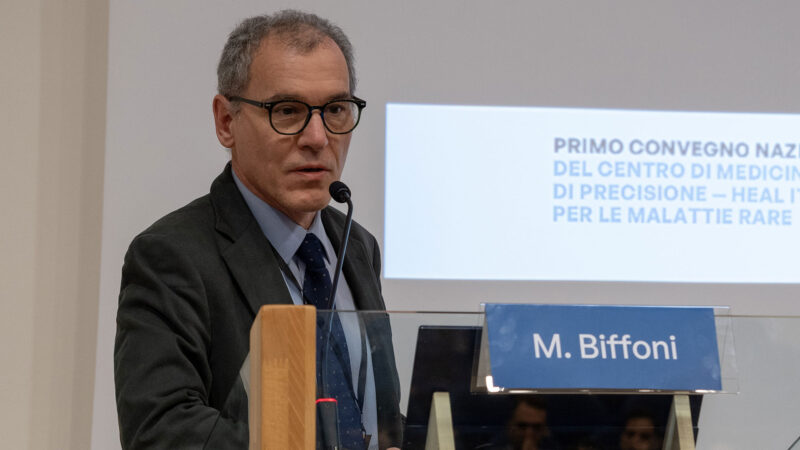
Prof. Mauro Biffoni opened his presentation by invoking a fundamental principle: “The ultimate goal is to bring something that has a real benefit for patients.” This statement, apparently obvious, in reality represents the guiding star that must direct the entire complex drug development pathway, from basic research to clinical practice.
In the field of oncology — and particularly when neoplasms approach the category of rare diseases due to their molecular specificity — this pathway presents particular features that require innovative regulatory and experimental approaches.
The history of precision oncology: from Imatinib to today
The modern history of precision oncology is commonly traced from the advent of Imatinib — an emblematic example of how a correct scientific hypothesis can lead to a radical change in the prognosis of a disease. It is a story almost 40 years long, beginning with the cytogenetic identification of the Philadelphia chromosome in the 1960s and arriving, after decades of research, at the development of Imatinib.
The Philadelphia chromosome is a chromosomal abnormality caused by a translocation between chromosomes 9 and 22, which generates a BCR-ABL fusion gene producing a constitutively active kinase protein that stimulates cell proliferation. Imatinib was designed specifically to inhibit this abnormal protein, changing the clinical history of chronic myeloid leukaemia — “a disease that was once fatal in 100% of cases in its advanced phase.”
From that initial success, other molecularly targeted drugs followed. Fortunately, the time needed to move from scientific discovery to clinical treatment has been considerably reduced. A recent example cited by Biffoni is that of ALK inhibitors — such as Crizotinib — which had a faster development timeline compared to Imatinib. Trastuzumab, which changed the prognosis of HER2-positive breast tumours, also represents an important example of a drug selective for a specific molecular target.
The complexity of the mutational landscape
Over time, however, the situation has become considerably more complex. The mutations found in tumours are numerous, and not all have the same predictive or therapeutic power as the Philadelphia chromosome. As Biffoni explained, “it is rarely a matter of a single ‘driver gene.’ Secondary mutations often emerge, conferring resistance to treatments and complicating the clinical course.”
Tumours are not static entities: they evolve over time, acquiring new mutations, some of which can render the tumour resistant to drugs that were initially effective. This clonal evolution represents one of the main challenges of precision oncological medicine.
The genomic sequencing revolution
A fundamental turning point was the reduction in the costs and time required for genetic sequencing. The contrast is striking: the first human genome required ten years and approximately two and a half billion dollars, involving a worldwide network of research centres. Today, for less than one thousand euros and in a single night, a complete genomic profile can be obtained in a single well-equipped laboratory.
This technological progress has made studies and treatments previously unthinkable possible. It has also transformed frequent tumours into a multitude of rare subtypes. As Biffoni highlighted, ALK mutations in lung tumours represent approximately 5% of cases, while ROS1 mutations represent approximately 2%. “New categories of rare diseases are thus born within conditions once considered homogeneous.”
This phenomenon has profound implications: a lung tumour with an ALK mutation is biologically and therapeutically very different from a lung tumour without that mutation. They are in fact different diseases that share an anatomical site but require completely different treatments.
New models of clinical experimentation
The molecular fragmentation of tumours has driven the development of new trial models — no longer based on traditional linear schemes (phase 1 for safety, phase 2 for preliminary efficacy, phase 3 for confirmation) but on flexible and dynamic models. Basket trials enrol patients with anatomically different tumours but a common molecular mutation who receive the same treatment; the idea is that a lung tumour and a colon tumour with the same driver mutation might respond to the same drug targeting that mutation. Umbrella trials take a single tumour type and subdivide it into subgroups treated with different drugs based on biomarkers — for example, a lung cancer trial might have different arms for patients with EGFR, ALK, ROS1 and KRAS mutations, each treated with the appropriate drug. Platform trials use a master protocol to govern the dynamic entry and exit of sub-studies based on emerging results: if one arm shows promising results it can be expanded, if it shows inefficacy it can be closed early, and new arms with different drugs can be added.
As Biffoni emphasised, “in oncology, these new models are now the norm.” They represent a necessary evolution to address the molecular complexity of tumours while maintaining the efficiency of experimentation.
Accelerating approval timelines
Another important evolution concerns approval timelines. There is an increasing tendency to obtain authorisation already at phase II, or even at phase I in the case of drugs for ultra-rare diseases. This paradigm shift reflects the need to balance scientific rigour with the urgency of providing therapeutic options to patients who would otherwise have none.
For very rare diseases with a serious prognosis, waiting for the results of a randomised and controlled phase III trial that might require years — and might not even be feasible due to insufficient patients — is ethically unacceptable. A lower level of evidence is therefore accepted in exchange for more rapid availability of the treatment.
European regulation of clinical studies
Since 2004, the authorisation of clinical studies has been centralised at European level. The new European Regulation, which entered into force recently after technical delays related to the development of the IT portal, has set stricter timelines: 45 days for authorisation, extendable by a further 50 only for advanced therapy medicinal products (ATMP).
The evaluation is articulated on two distinct levels. Scientific-clinical evaluation is centralised and harmonised between EU countries, assessing the study design, endpoints, inclusion/exclusion criteria and participant safety. Ethical evaluation remains a national competence in order to respect the regulatory specificities of each country, assessing aspects such as informed consent, the protection of vulnerable subjects and the risk-benefit balance from an ethical standpoint.
This dual evaluation guarantees both high scientific standards harmonised at European level and respect for national ethical and regulatory sensibilities.
The strategic value of clinical experimentation
Biffoni emphasised an important point: “Clinical experimentation, in addition to representing an economic driver, also has a very high value for patients, who can thereby access therapies that would otherwise be unavailable. Being competitive in experimentation is therefore strategic both for the healthcare system and for citizens.”
This is particularly true for rare diseases and rare tumours. A patient with a form of tumour for which no effective approved therapies exist may find in the clinical trial the only possibility of accessing a potentially beneficial treatment. Clinical trials are therefore not only research instruments, but also care pathways.
The European approval pathway
Once clinical experimentation is completed and sufficient data obtained, the true regulatory phase begins. The application for marketing authorisation is submitted at European level and evaluated by the CHMP (Committee for Medicinal Products for Human Use) of the EMA, which provides an opinion to the European Commission, which issues the final decision binding for all Member States.
Decisions can take various forms. Full approval is granted when the evidence of efficacy and safety is solid and complete. Conditional approval is granted with an obligation to provide further data over time — used when there is an unmet medical need and preliminary data are promising but not yet complete. Approval under exceptional circumstances is particularly relevant for rare diseases, where it is impossible to collect evidence comparable to that of more common conditions, but where the urgency of making the drug available is nonetheless recognised.
This last modality is particularly important for ultra-rare diseases, where it may be impossible to conduct randomised controlled trials due to the extremely limited number of available patients.
The national pathway in Italy
After European approval, each Member State must navigate its own national drug access pathway. In Italy, this occurs through AIFA (the Italian Medicines Agency), which evaluates the classification of the drug (territorial distribution through pharmacies, or direct hospital distribution), eligibility for reimbursement by the National Health Service, and the price — through a negotiation process with pharmaceutical companies.
To this is added the evaluation of innovativeness — specific to Italy — which can establish faster or dedicated access pathways for drugs considered particularly innovative.
The equity of the Italian healthcare system
Biffoni emphasised a fundamental aspect of the Italian system: “Our National Health Service, unlike other countries, guarantees drugs to patients regardless of their economic condition. This is a fundamental value to be preserved, especially in the context of the rising costs of Precision Medicine.”
In many other countries — even developed ones — access to very expensive drugs can depend on the patient’s economic capacity or their private health insurance. In Italy, once a drug is approved and reimbursed, all patients who need it can access it free of charge or with a symbolic co-payment. This equity principle is particularly important for innovative oncological drugs, which can have very high costs.
Tools to accelerate access
In addition to the standard approval and reimbursement pathway, complementary tools exist to make drugs not yet approved or reimbursed available. Law 648/96 allows the use of drugs at the request of clinicians in the presence of at least phase II evidence, even if the drug is not yet approved in Italy for that indication. The AIFA 5% Fund is fed by a share of advertising expenditure paid by pharmaceutical companies and serves to cover the costs of innovative individual treatments — often in rare or ultra-rare diseases — allowing patients to access therapies that would otherwise be unavailable. Free distribution is another mechanism: some pharmaceutical companies provide drugs free of charge even in the absence of public reimbursement, to facilitate access to treatments while awaiting final approval.
All of these tools contribute to reducing the time and economic barriers that separate innovation from the effective care of the patient.
The challenges of evaluation
The evaluation of these drugs presents numerous complexities, particularly for those intended for rare or ultra-rare diseases. Clinical studies are often conducted on very restricted populations, with evident limitations. The lack of control groups means these are often single-arm studies, or studies with historical comparisons that are not always reliable — it is difficult to randomise patients when a potentially life-saving treatment exists, and difficult to recruit sufficiently large control groups when patients are very few. The use of surrogate endpoints means that instead of measuring survival (which would require very long follow-up periods), intermediate endpoints are assessed — such as the reduction of infections in cystic fibrosis or radiological response in tumours, which do not always correlate perfectly with real clinical benefits. Short follow-up periods are insufficient to fully assess long-term efficacy and safety — when a drug is approved on the basis of data at 6–12 months, the effects at 5–10 years are unknown.
These limitations are inevitable when dealing with rare diseases, but they create uncertainty in the assessment of the risk-benefit ratio.
The problem of costs
To these methodological elements is added a central problem: cost. As Biffoni emphasised, “drugs for rare diseases — and in particular those of a genetic or innovative oncological type — reach very high figures, in some cases exceeding 3 million euros per patient.”
These astronomical costs derive from several factors: enormous investments in research and development, high production costs (especially for personalised cell and gene therapies), the need to recoup investments over a very limited number of patients, and pharmaceutical company pricing strategies.
“At present the system is able to sustain these costs, but it is not guaranteed that it will be so in the future,” warned Biffoni. With the increasing number of innovative therapies and the growing life expectancy of treated patients (who might require treatment for longer periods), economic sustainability becomes a crucial issue.
Tools for expenditure management
To address this challenge, expenditure management and optimisation tools must be activated. Payment by result agreements mean the healthcare system pays only if the drug actually works in the specific patient — if after a treatment period the patient does not respond, the company reimburses the cost. Post-marketing monitoring through patient registries of treated patients allows assessment of real-world efficacy in clinical practice, not only in controlled studies. Targeted use of dedicated funds concentrates limited resources on cases where the evidence of benefit is strongest.
The global growth of advanced therapies
Biffoni presented data on the global trend in spending on advanced therapies. CAR-T therapies are increasing strongly worldwide, reflecting both the approval of new products and the expansion of indications. Spending on gene therapies is more stable but nonetheless growing.
It is interesting to note that classifications can vary between jurisdictions: in the United States CAR-T therapies fall under cell therapies, while in Europe they are considered gene therapies (because the cells are genetically modified), with different regulatory implications.
The challenge of equilibrium
Concluding his presentation, Biffoni identified the main challenge for the coming years: “Reconciling innovation, equity and sustainability. Precision Medicine has already radically changed the therapeutic paradigm, but to translate these discoveries into real benefits for all patients, it will be fundamental to continue working in a coordinated manner between regulatory bodies, healthcare institutions, clinical centres and industry.”
This balance is particularly delicate. On the one hand, innovation cannot be slowed: patients with rare diseases have the right to benefit from scientific advances as rapidly as possible. On the other hand, the sustainability of the public healthcare system cannot be compromised — because without a sustainable system there will be no equity of access for all.
The role of HEAL ITALIA in this context
Although not explicitly discussed in the presentation, the role of the HEAL ITALIA programme emerges clearly in this context. The Precision Medicine Centers — with their research infrastructures, biobanks and integrated competencies — represent exactly the type of ecosystem needed to conduct high-quality clinical trials even on limited numbers of patients; identify the appropriate biomarkers for patient stratification; contribute to patient registries for post-marketing monitoring; train professionals capable of managing the complexity of Precision Medicine; and facilitate the technology transfer from research to clinical practice.
Prof. Biffoni’s presentation showed how the pathway from discovery to cure is complex, requires diverse and integrated competencies, and must balance sometimes contrasting needs. It is precisely in this scenario that infrastructures such as HEAL ITALIA can make the difference — accelerating innovation while maintaining scientific rigour and guaranteeing equity of access, thereby contributing to transforming the promise of Precision Medicine into concrete reality for all patients, including those with the rarest diseases.