
From the laboratory to the market: the challenges of technology transfer in Precision Medicine
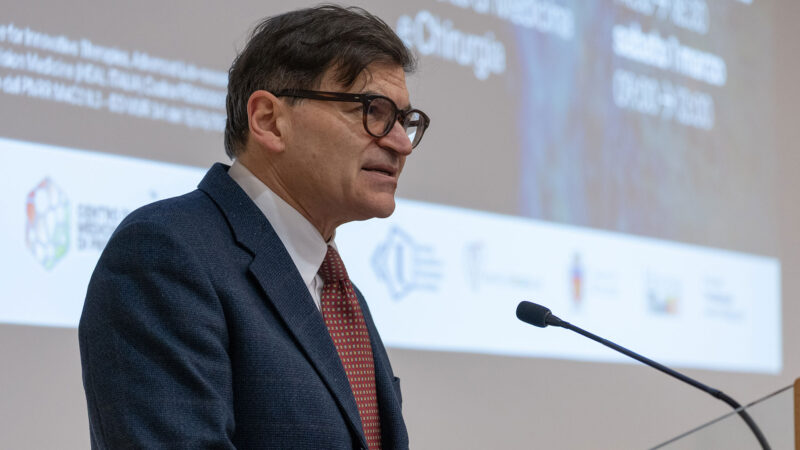
The starting point of Prof. Giua Marassi’s analysis is a surprising and concerning figure. “I went to ask ChatGPT: how many of these patents born in academia then become commercial products, drugs or usable solutions? Well, not even ChatGPT was able to give me a precise answer,” he began with a touch of irony.
The lack of precise data is in itself symptomatic of a problem: the system does not effectively monitor its own success rate in transforming research into innovation. However, the available figures paint a clear picture. In 2023 in Italy, 3,221 national invention patents were granted — an increase of 12.2% compared to 2022 — and 4,773 European patent applications were filed.
Yet, despite this apparent vitality of Italian innovation, the share of the total European applications has decreased. Even more concerning is Italy’s low percentage in the technology sectors linked to health (healthtech) and information (ICT) — precisely the sectors that are crucial for Precision Medicine.
The most significant figure, however, concerns the percentage of patents that actually become products. According to estimates, this is 5–10% at best, but other data indicates even lower figures, between 1 and 2%. “In any case, at least 90% of patents remain in the drawer of universities,” concluded Giua Marassi frankly.
This means that the enormous intellectual and economic effort invested in public research produces results that, in the vast majority of cases, never reach patients. A systemic inefficiency that, in the field of rare diseases where every therapeutic opportunity is precious, becomes particularly serious.
Theory and reality of tech transfer: a chasm
In theory, the model of collaboration between academia and industry is perfect and complementary. Academia provides innovation, scientific know-how and basic research, while industry offers development, production, regulatory and commercialisation capabilities. Public-private partnerships, research consortia, incubators and academic spin-offs are often discussed.
“But between theory and reality there is a chasm,” stated Prof. Giua Marassi without mincing words. This chasm is fed by six main categories of obstacles that prevent the effective transfer of technology from the laboratory to the market.
The six challenges of technology transfer
1. Divergent objectives
The first obstacle is cultural and strategic in nature: academia and industry have fundamentally different objectives. Academia wants to publish, disseminate knowledge, train young researchers, advance scientific understanding. Academic success is measured in publications in prestigious journals, citations and recognition from the scientific community.
Industry, on the other hand, wants to develop and sell products that improve the lives of patients while generating an economic return for investors. Industrial success is measured in approved drugs, treated patients, turnover and profits.
These differences are not superficial: they determine different priorities, different timescales and different evaluation criteria. An academic researcher can be perfectly satisfied having published an article demonstrating a new molecular mechanism, even if that mechanism will be difficult to translate into therapy. A pharmaceutical company, on the other hand, will evaluate that discovery based on its “druggability” — the concrete possibility of developing a drug based on that mechanism.
2. Bureaucracy and administrative complexity
Licensing processes are slow and complex. Negotiating intellectual property between universities and companies takes months, sometimes years. Patent management is complicated and costly. Universities often do not have technology transfer offices adequately staffed with expert personnel.
This bureaucratic slowness is particularly damaging in sectors such as pharmaceuticals, where timing is crucial. A one-year delay in starting preclinical development can mean one year less of patent protection when the drug reaches the market, with enormous economic implications.
3. Cultural barriers
Academia and industry operate with profoundly different mindsets, languages and timescales. As Giua Marassi explained, “Industry needs today, academia works on the long term.”
An academic researcher can spend years perfecting a technique or understanding all the details of a biological mechanism. An industrial project manager must respect precise milestones, defined budgets and tight deadlines. These differences create mutual misunderstanding and frustration.
Furthermore, there is often a lack of mutual understanding: academic researchers may not understand the regulatory and commercial constraints that guide industrial decisions, while industrial managers may not appreciate the scientific complexities and the need to explore hypotheses that may not have an immediate application.
4. Economic sustainability
Funds for research and clinical development are limited. Academic research is typically funded through competitive grants of limited duration (2–5 years) and with relatively modest budgets. Developing a drug from initial discovery to regulatory approval, on the other hand, requires hundreds of millions of euros and 10–15 years.
A “valley of death” therefore exists — the death valley of funding — between the end of basic research funding and the beginning of industrial interest. A promising discovery can remain stuck in this valley because it is too advanced for academic funding but too early-stage for industrial investment.
As Giua Marassi emphasised, “even after the research phase, capital is needed to industrialise.” Having a promising active compound is not enough: the production process must be developed, clinical studies conducted, regulatory approvals obtained and distribution organised.
5. Access to data
Clear standards for the management and sharing of clinical and biological information are lacking. Industry needs to know how many patients exist for a given condition, where they are located, what characteristics they have, whether biological material is available in biobanks.
“Without data, there is no investment,” stated Giua Marassi categorically. A pharmaceutical company cannot decide to invest tens of millions of euros in the development of a drug for a rare disease without a reliable estimate of the potential patient population.
Biobanks and patient registries are crucial, but they must be organised in such a way as to make information accessible while respecting privacy. Interoperability between different systems is needed, along with standardisation of data collection protocols and clarity on how companies can access these resources.
6. Uncertain regulation
In the field of Precision Medicine and rare diseases, it is not yet clear how to validate new approaches. Regulatory agencies such as the EMA and FDA are still defining the frameworks for evaluating personalised therapies, gene therapies and companion diagnostics.
Giua Marassi recalled an impressive figure: “Of rare diseases there are 8,000 but only for 300 is there a therapy.” This means that for 96% of rare diseases no approved treatment yet exists. Regulatory uncertainty contributes to this situation, discouraging investment in an already risky field.
Concrete proposals to bridge the gap
After diagnosing the problems, Prof. Giua Marassi proposed concrete solutions based on his direct experience in the sector.
Flexible partnership models
Collaboration models must be created with balanced incentives and more fluid management of intellectual property. There is no single model valid for all cases: some collaborations work better with exclusive licences, others with non-exclusive licences, others still with joint ventures or spin-offs.
Incentives must be aligned: the university must benefit economically from the commercial success of its discoveries, but not in a way that makes the cost of licensing prohibitive for the company. Individual researchers must be recognised and rewarded, but without creating conflicts of interest that compromise scientific objectivity.
Simplification of the process
A clear regulatory framework and streamlined procedures for technology transfer are necessary. Technology transfer offices at universities must be strengthened with personnel expert in both scientific and commercial and legal aspects.
Licensing contract negotiation processes should be standardised for the most common situations, reserving complex negotiations only for truly exceptional cases. Many successful American universities use pre-negotiated contract templates that drastically reduce timescales.
Greater involvement of venture capital and public funds
To bridge the funding “valley of death,” greater availability of risk capital and dedicated public funds for preclinical and initial clinical development is needed. Tools such as proof-of-concept funds, managed by universities or consortia, can finance the studies necessary to make a discovery attractive to industrial investors.
Venture capital specialised in biotech can play an important role, but in Italy this sector is still underdeveloped compared to the United States. Tax incentives and a more favourable ecosystem for high-risk investment in biomedical innovation are needed.
A culture of collaboration from the outset
Perhaps the most important point emphasised by Giua Marassi is the need to promote collaboration between academia and industry from the earliest stages of research, not retrospectively. “Often researchers work for years on an idea without knowing whether it is really needed. And industry does not know what the researchers are doing. So everyone goes their own way, and then it is too late when they meet.”
Multidisciplinary projects are needed that involve academic researchers, clinicians and industry representatives from the outset. Joint training is important: researchers must understand what it means to develop a drug, and industrial managers must appreciate the complexity of scientific research.
Shared digital platforms
The development of digital platforms for managing and cross-referencing data is crucial. Biobanks, patient registries and genomic databases must be interconnected and accessible according to clear rules.
Industry needs this information to make informed investment decisions. A company must be able to estimate how many patients could benefit from a new drug, what their characteristics are, where they are geographically located and what the current standards of care are.
Industry’s self-criticism
A particularly commendable aspect of Giua Marassi’s presentation was his willingness to engage in self-criticism. “I do not want to say that the fault lies with the university. Industry too has its responsibilities. Every company works for itself, without collaborating. There is only competition. And fierce competition.”
This observation is important. Pharmaceutical companies compete fiercely with one another, often duplicating efforts and investments on similar targets rather than collaborating on some phases of development and competing on others. In the field of rare diseases, where patients are few, this competition can be inefficient.
Some recent initiatives — such as pre-competitive consortia in which different companies share data on the early stages of drug development — demonstrate that it is possible to collaborate while maintaining competition where it is appropriate.
Time as a critical factor
A recurring theme in the presentation was the importance of time. “For industry, time is fundamental. It is not an independent variable,” Giua Marassi emphasised. In the pharmaceutical sector, every year of delay in drug development has enormous costs: direct development costs, opportunity costs and above all years of lost patent protection.
But time is also critical for patients. In the case of rare diseases — especially those that affect children — every year of delay in the arrival of a therapy means suffering, disease progression, lives compromised or lost.
Accelerating technology transfer, removing bureaucratic inefficiencies and simplifying processes is not merely a matter of economic efficiency: it is an ethical matter.
A final appeal: we are all patients
Prof. Giua Marassi concluded his presentation with a powerful appeal: “Because, in the end, we are all patients. Sooner or later, we all will be. The faster we act, the better.”
This statement returns the discussion to its fundamental human dimension. Beyond questions of patents, licensing, venture capital and regulation, there is a moral imperative: people who suffer from rare diseases need therapies, and society has a duty to do everything possible to transform scientific discoveries into concrete cures.
The role of large pharmaceutical companies, from this perspective, is not only to maximise profits for shareholders, but to guide the innovation process, invest in long-term collaborations and support research even when the economic return is not immediate.
HEAL ITALIA as a model of integration
Giua Marassi’s presentation implicitly recognised in HEAL ITALIA a model that seeks to address many of the problems identified. The programme was born as an extended public-private partnership, including universities, IRCCS, research institutions and private companies from the outset.
The Precision Medicine Centers with their certified biobanks, patient databases and technology platforms represent exactly the type of shared infrastructure that facilitates technology transfer. The presence of thematic spokes covering the entire pathway from basic discovery (Spokes 1–3) through to clinical validation (Spoke 8) ensures continuity and integration.
The involvement of industry from the very beginning in the design of the programme should ensure that the research produced is relevant to the development of concrete therapies. The multi-year duration of PNRR funding offers that continuity which is essential for carrying complex projects forward.
Naturally, as Giua Marassi himself implicitly acknowledged, the mere existence of this infrastructure is not sufficient. Continued commitment will be needed to maintain dialogue between academia and industry, to simplify processes, to attract additional private investment and to ensure that results actually reach patients.
But the fact that a representative of one of the world’s largest pharmaceutical companies actively participates in a conference on a nascent Precision Medicine Center — openly sharing challenges and proposing solutions — is already a positive signal of that integration between the two worlds that is necessary to transform the promise of Precision Medicine into therapeutic reality for patients with rare diseases.