
Precision Medicine and New Challenges of Biomedical Research: The Scientific Introduction to the HEAL Italia Conference
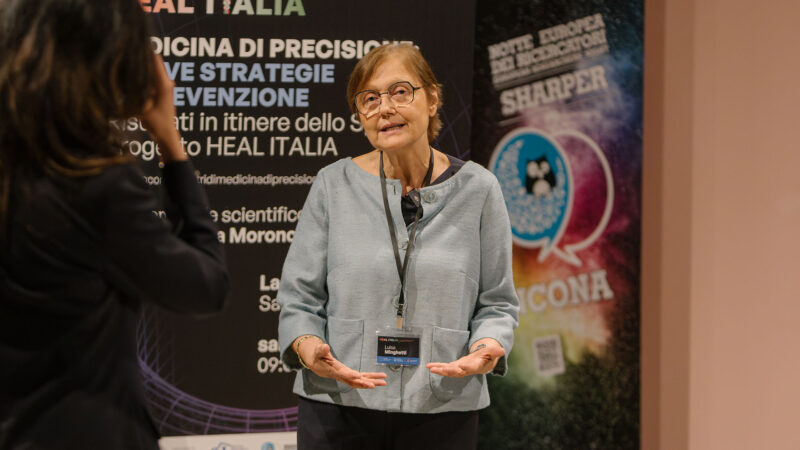
During the event HEAL ITALIA Precision Medicine: New Prevention Strategies, held on Saturday 27 September 2025 in Ancona to present the interim results of Spoke 7 of the HEAL ITALIA Project, Prof. Luisa Minghetti delivered the scientific introduction to the day. In her presentation she emphasised the importance of multidisciplinary collaboration between biologists and physicians, the crucial role of new technologies in transforming medicine, and the need for clear rules to govern innovation in biomedical research — tracing the conceptual coordinates of the entire conference day.
Precision Medicine as a multidisciplinary challenge
Prof. Luisa Minghetti opened the conference proceedings with a reflection on the collaborative nature of research in Precision Medicine. Responding to the introductory presentation, she immediately wished to clarify her own role and perspective: “Gianluca always gives me introductions that leave me embarrassed, and I am not an important figure for healthcare — let us say that I have sought to, I have conducted research for many years and then at a certain point in the institute I was given this delegation for research, so I am trying to contribute to research in the health field.”
With this premise of humility, typical of those who work with scientific rigour, Minghetti emphasised that her objective is to contribute to research within her own institute, without any pretension of revolutionising the entire healthcare system: “I hope to have made at least some contribution to the reality of my institute — I do not expect to go and extend the boundaries of the whole of healthcare. Absolutely not.”
The three fundamental pillars: professionalism, rules and technologies
After thanking Prof. Gianluca Moroncini for organising the event and the authorities present, Minghetti identified three fundamental themes that had emerged from the institutional presentations — representing three challenges for the future of Precision Medicine.
The first theme concerns collaboration between biologists and physicians. The professor highlighted how the panel of speakers represented a concrete example of this synergy: “I begin from the union between biologists and physicians. This panel is an example. I am a biologist and he is a physician and we have worked extremely well together.” This interdisciplinary collaboration is not only desirable, but necessary to address the complexity of contemporary medicine.
The second fundamental theme is new professional figures. As the speaker emphasised, this is “an absolutely fundamental topic” for the future development of the healthcare sector. Precision Medicine in fact requires increasingly specialised and at the same time transversal competencies, capable of integrating knowledge from different disciplines.
The third aspect concerns rules — a theme to which the Istituto Superiore di Sanità is “extremely sensitive.” The need for a clear and updated regulatory framework is essential to ensure that technological innovation proceeds in a safe and ethically correct manner.
Technologies: opportunities to be governed
Particular emphasis was placed on the theme of emerging technologies. Minghetti expressed clearly a balanced position that recognises innovative potential without falling into uncritical enthusiasm: “Technologies are outpacing us. We absolutely need to use them and they are tools — they must not take over. We need clear guidance, because these are technologies that can truly change the approach to medicine, but we must govern them and we need precise indications.”
This statement encapsulates a fundamental principle: technologies must remain tools in the service of medicine and must not become ends in themselves. The ability to “govern them” requires not only technical competencies, but also an adequate regulatory framework and constant ethical reflection.
The challenge of the HEAL Italia project: results within tight timeframes
Speaking about the experience of carrying out the project, Prof. Minghetti described writing the spoke as “a good experience,” while also highlighting the difficulties encountered. The sub-project presented is part of a large project involving a very high number of researchers, and as she explained, it represented a particular challenge: “Among all the spokes, this was the one that had to bring together different approaches and, within a timeframe of 3 years or even less, try to produce some results.”
The complexity increases when speaking of prevention — an area where research timescales are naturally more extended: “When speaking of prevention, timescales stretch out. It is very difficult in 3 years to identify profiles or markers that are already validated and can be presented as results to apply in prevention strategies.”
This observation touches on a critical point of contemporary biomedical research: the tension between the need to produce results within relatively short timeframes (imposed by funding and research programmes) and the natural timescales of scientific validation — particularly long when it comes to prevention and predictive medicine.
The commitment of the research groups and the selection of results
Despite these objective difficulties, Minghetti wished to emphasise the commitment put in by the research groups involved: “But we gave it everything we had — we involved excellent groups, and today we will have a taste of the results that have been obtained.”
She then explained that the selection of results to present during the conference was made “in a very considered manner” by Prof. Moroncini, with the aim of showing “results representative of the entire spoke.” This methodological choice reflects the breadth of the project and the need to offer an overview that, while not exhaustive, was meaningful of the totality of the work carried out.
A strategic vision for biomedical research
Prof. Minghetti’s presentation traced the conceptual coordinates of the entire conference day, highlighting how Precision Medicine is not merely a question of advanced technologies, but requires effective interdisciplinary collaboration between different professional figures — in particular between biologists and physicians; the development of new professional competencies capable of operating in this complex and rapidly evolving context; a clear regulatory framework that makes it possible to govern technological innovation while keeping it in the service of public health; the capacity to manage emerging technologies that have the potential to radically transform the approach to medicine, but which must be integrated in a conscious and controlled manner; and a realistic vision of the timescales needed for research in the preventive sphere, which cannot be forced beyond certain limits without compromising the quality and validation of results.
The introduction thus prepared the ground for the subsequent presentations, offering an interpretive framework that allowed the value and scope of the individual research projects presented during the day to be understood.