
Sardinia as a genetic laboratory: rare variants in common tumours
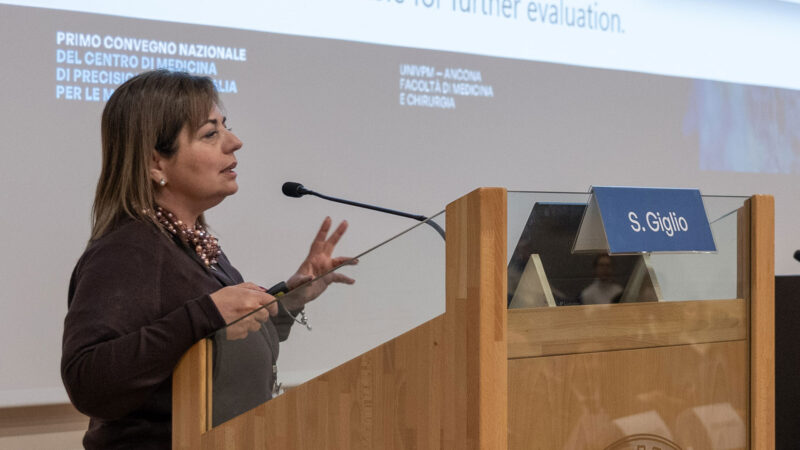
Dr. Giglio opened her presentation with an important premise: “I would like to show you how rare genetic variants are present even in common tumours.” This statement may seem counterintuitive. We are accustomed to thinking that rare variants belong exclusively to rare diseases and have no implications in common conditions such as tumours.
In reality, as she explained, “what genetics has taught us in rare diseases is also crucial for understanding common diseases.” In rare monogenic diseases, a single mutated gene can explain the entire condition with high penetrance. In tumours, the situation is more complex: when a tumour tissue is analysed — especially in younger patients — up to 50,000 genetic variants can be found.
How does one distinguish which are truly relevant to the condition? Among these thousands of variants, there are also constitutional ones — hereditary variants that predispose to the disease. “Ultimately, even if 50,000 variants are identified in an advanced tumour, those truly significant for therapy are perhaps 15 or 20. But one needs to know how to interpret them, because they make all the difference,” emphasised Dr. Giglio.
Beyond BRCA: a broader vision of tumour predisposition
Traditionally, hereditary tumours have been divided into two broad categories: breast and ovarian cancer, linked to the BRCA1 and BRCA2 genes, and intestinal polyposes, linked to mismatch repair genes. However, recent research has demonstrated that this division is too simplistic.
“Today we know that BRCA genes can also be involved in intestinal tumours, and mismatch repair genes also in breast tumours,” explained Dr. Giglio. This discovery requires a change of approach: we can no longer limit ourselves to looking only for BRCA in breast tumours or only mismatch repair genes in intestinal tumours. We must better understand the genetic mechanisms that lead to the development of tumours, including through genes normally associated with other organs.
The Sardinian context: a unique population
In Sardinia, tumours represent the leading cause of death — unlike the rest of Italy, where this primacy belongs to cardiovascular diseases. Furthermore, tumours in the Sardinian population appear to be more aggressive, with less effective responses to standard treatments.
A particularly interesting figure concerns the BRCA genes: “BRCA1 and BRCA2, known for their association with breast and ovarian tumours, are much less frequent in our population compared to other Italian or European populations. For example, BRCA1 has a frequency of 13% and BRCA2 of 7% — among the lowest in absolute terms,” reported Dr. Giglio.
Where are more variants found in the Sardinian population? In the ATM gene, which is nonetheless part of the DNA repair pathway alongside BRCA. But an unexpected protagonist also emerges: the PARKIN gene, traditionally known for its role in juvenile Parkinson’s disease.
PARKIN: from neurological gene to tumour suppressor
The discovery of the tumour suppressor role of PARKIN represents a perfect example of how the study of rare diseases can illuminate mechanisms relevant to common conditions. “Some of its variants, in specific domains, are linked to tumour predisposition,” explained Dr. Giglio.
Analysis of tumour tissues has revealed that the PARKIN protein is altered in over 50% of cases, suggesting an important role in oncological mechanisms. Furthermore, PARKIN interacts with the p53 gene — one of the most important known tumour suppressors and a fundamental regulator of cell proliferation and the response to DNA damage.
This discovery has immediate practical implications: patients with tumours presenting alterations of PARKIN might benefit from different therapeutic strategies compared to those with BRCA alterations, because they involve different molecular pathways.
GNAS and mTOR: when rare developmental diseases meet oncology
Another fascinating example concerns the GNAS gene, traditionally associated with rare developmental diseases. “In the presence of rare variants, they can predispose to breast tumours,” explained Dr. Giglio. In the Sardinian population, families with these variants are observed — often initially confused with BRCA-like syndromes.
However, these patients respond to different drugs compared to those with BRCA mutations, because GNAS variants involve different pathways — in particular that of mTOR. This distinction is crucial for Precision Medicine: administering a PARP inhibitor (effective in BRCA-mutated tumours) to a patient with GNAS mutations would be ineffective. A therapeutic approach targeting the mTOR pathway is instead required.
“This awareness is fundamental for a real Precision Medicine, because we can no longer limit ourselves to looking only for BRCA: we must broaden our gaze to the entire landscape of variants that influence predisposition and response to therapies,” concluded Dr. Giglio on this point.
Multiple myeloma: a case study in the Sardinian population
Moving to multiple myeloma — a blood tumour affecting plasma cells — Dr. Giglio highlighted that this disease is also very prevalent in the Sardinian population, with a more severe course compared to other Italian regions.
Genetic analyses have revealed germline variants in BRCA pathway genes with a frequency of 24% — far higher than in the general Italian Caucasian population. But the most interesting discovery concerns a rare variant in the CHIA gene.
“In international databases such as GNOMAD, this variant has a frequency of 0.004%, while in Sardinia it reaches almost 0.02% — therefore 10 times higher,” she explained. This variant, if present in homozygosis (on both chromosome copies), is associated with rare ciliopathies such as Joubert syndrome — a severe neurological developmental disease.
However, in Sardinia no homozygous individuals for this variant are observed: “It is probably too disadvantageous in biallelic form,” hypothesised Dr. Giglio. Natural selection has eliminated homozygotes, but the presence in heterozygosis (one mutated copy only) is significant.
The Sardinian haplotype and ARID4A
The CHIA variant is part of a broader haplotype — a block of DNA inherited together that contains multiple genes. Within this haplotype there is another gene: ARID4A, which contains “an upstream, intronic variant found exclusively in Sardinians.”
ARID4A plays an important role in the epigenetic regulation of myeloma, controlling which genes are active or silenced in tumour cells. Its alteration could explain why multiple myeloma is more aggressive in the Sardinian population.
“Without the study of this rare variant, we would never have identified the role of the haplotype. This is a perfect example of how the study of isolated populations and rare variants can provide fundamental insights even for common and serious conditions,” stated Dr. Giglio.
Rare variants determine the most severe phenotypes
A general principle emerging from the research is that in common complex diseases, the most severe forms are often associated with rare variants. “Rare variants, although little considered in common diseases, play a fundamental role. It is increasingly evident, also from the literature, that rare variants are often those that determine the most severe phenotypes,” she emphasised.
In familial hypercholesterolaemia, for example, the most severe forms are not due to common variants but to rare mutations in genes such as LDLR or PCSK9. The same applies to many other complex diseases: neurodegenerative conditions, hypertension, diabetes. The most aggressive forms are often linked to the presence of rare variants in combination with common polymorphisms.
Sardinians as “living knockouts”
Sardinia represents an ideal model for studying these dynamics thanks to its relative genetic homogeneity and the presence of numerous rare variants. As Dr. Giglio explained, citing colleague Andrea Perra, Sardinians are “living knockouts”: carriers of potentially pathological mutations that however do not manifest phenotypically.
“This allows us to understand the mechanisms of compensation, of protection, and therefore to learn something useful for everyone,” she stated. Studying why some people with theoretically harmful genetic variants remain healthy can reveal protective mechanisms that could potentially be exploited therapeutically.
Two million variants and 41% absent from international databases
The data are impressive. Studying the first 2,000 Sardinian exomes — of which approximately 1,400 from “pure Sardinians” (individuals with all four grandparents Sardinian) — over 2 million genetic variants emerged. Of these, approximately 41% are absent from international databases such as GNOMAD or from the Pangenome.
This means that almost half of the genetic variants present in the Sardinian population have never been described in other populations. Among these, 35,000 are loss of function variants — mutations that should completely inactivate a gene — and many are present in homozygosis, on both alleles.
“Yet, we do not observe the expected conditions,” emphasised Dr. Giglio. This apparent paradox reveals the existence of genetic compensation mechanisms still to be fully understood.
The case of connexin 26
A concrete example concerns the GJB2 gene, which codes for connexin 26 — the main cause of non-syndromic genetic deafness. “In Sardinia we have a very high frequency of heterozygous carriers, comparable to that of thalassaemia or G6PD deficiency. Yet, we are not all deaf,” observed Dr. Giglio.
Evidently there exist upstream variants, unique to the Sardinian population, that protect against the manifestation of deafness even in the presence of pathogenic GJB2 mutations. Identifying these protective variants could open new therapeutic avenues for genetic forms of deafness.
Towards the pharmacogenetic passport
This understanding of the genetic variability of the Sardinian population has immediate practical implications for Precision Medicine. Dr. Giglio’s group is working on a “pharmacogenetic passport” — a personalised genetic profile of each patient that collects information on the variants relevant to drug response and disease predisposition.
“To propose them already now to the Medical Association and begin using them in clinical practice,” she explained. The idea is that every Sardinian patient could have a genetic profile guiding therapeutic choices: which drugs are most effective given their genetic variants, which have a greater probability of side effects, which dosages are appropriate.
This passport would not be only for oncology, but for all of medicine — from cardiology to neurology, from psychiatry (for psychotropic drugs) to infectious diseases (for antivirals and antibiotics).
Isolated populations as a resource for global medicine
Dr. Giglio’s presentation highlighted an important principle: studying genetically isolated populations such as the Sardinian one is not an academic exercise of local interest, but a powerful strategy for understanding biological mechanisms relevant to all of humanity.
Isolated populations have different frequencies of genetic variants compared to cosmopolitan populations. Some variants that are rare elsewhere are common in isolated populations, making it possible to study their effects with sufficient statistical power. Conversely, some variants that are common elsewhere are rare or absent in isolated populations, creating “natural experiments” in which one can observe what happens in the absence of those variants.
Furthermore, isolated populations often have particular demographic histories (founder effects, bottlenecks) that can lead to the fixation of protective or deleterious variants that in other populations would have remained rare.
The Precision Medicine Center in Cagliari
The presentation concluded with an acknowledgement to Prof. Andrea Perra: “This centre would not exist without him.” The HEAL ITALIA Precision Medicine Center in Cagliari, coordinated by Dr. Giglio and Prof. Perra, is dedicated to the study of the genetic bases of complex and oncological diseases in the Sardinian population, with the aim of translating this knowledge into concrete clinical applications.
The centre makes use of advanced genomic sequencing technologies, single-cell multi-omic analyses and tissue biobanks. Collaboration with the CeSAR (University Research Services Centre) of the University of Cagliari provides the necessary technological infrastructure.
A message of hope
Dr. Giglio’s presentation conveyed an important message: studying DNA does not only mean predicting diseases, but also “learning how to prevent them and manage them in a personalised manner.” Genetic variants are not a verdict, but information that — if correctly interpreted in the appropriate clinical context — can guide more effective therapeutic decisions.
The Sardinian population, with its peculiar genetic structure, offers a unique opportunity to understand the mechanisms of common diseases through the study of rare variants. This knowledge, integrated into the infrastructure of the HEAL ITALIA Precision Medicine Centers, can translate into concrete benefits for Sardinian patients and, more broadly, for all patients with complex diseases in which rare variants play a determining role.
As demonstrated by the examples presented — from PARKIN to GNAS, from CHIA to ARID4A — what we learn by studying rare diseases and genetically isolated populations has implications that extend well beyond the apparent boundaries of these categories, illuminating fundamental mechanisms relevant to the health of all.