
The Person, Not the Diagnosis: Precision Oncology
Two women sitting in the same waiting room. The same report, the same diagnosis: breast cancer. Yet what lies behind those words is biologically different — distinct genetic profiles, different growth rates, different responses to drugs. Treating them in the same way would mean getting it wrong at least half the time. Precision medicine begins with this awareness: every patient is unique, and today we have the tools to see it.
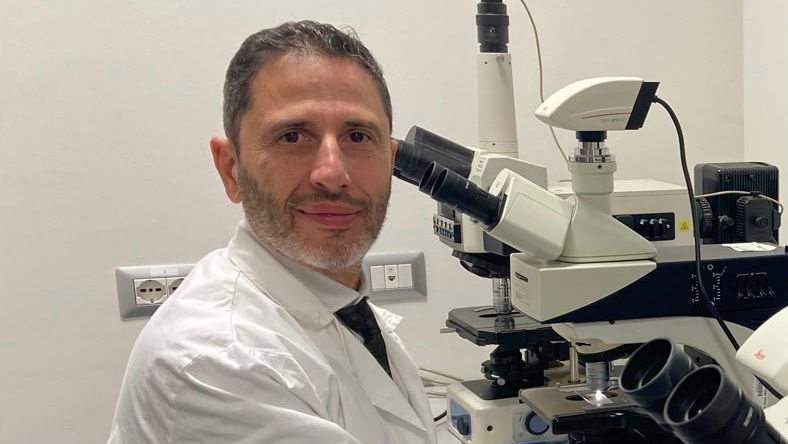
Dr. Eriseld Krasniqi works at that boundary every day. A medical oncologist at the Istituto Nazionale dei Tumori Regina Elena in Rome, specialised in breast cancer across clinical practice, preclinical research and clinical trials, he is also pursuing a PhD in artificial intelligence and data science — convinced that the oncology of the future is being built precisely in that space between biology and technology.
Dr. Krasniqi, who is precision medicine really for?
“Every time you hear the phrase precision medicine, people immediately think of something highly sophisticated, almost reserved for a few centres of excellence, for patients with rare or exceptional conditions. But the fundamental point is exactly this: precision medicine was born to serve everyone. Before patients, even citizens. It is simply a different way of thinking about health and disease — no longer a one-size-fits-all approach, but one that tries to account for the specific characteristics of each individual.”
In oncology, this difference is already clinical reality. Two patients with the same breast cancer diagnosis may have profoundly different diseases at the biological level: distinct genetic characteristics, different growth rates, responses to drugs that cannot be predicted without looking deeper. But precision medicine does not concern only those who are already ill.
What changes for people who are still healthy?
“It is also directed at healthy people — or rather, at people who can benefit from more targeted prevention strategies. Think of hereditary predispositions, for example to the BRCA1 and BRCA2 genes. In these cases, precision medicine does not come into play only once a diagnosis has been made, but also in surveillance, by creating specific pathways for prevention and genetic counselling. Precision does not only mean better treatment — it also means better prevention.”
There is also a dimension that is often overlooked: families. When we speak of genetic risk, we are never speaking of an isolated individual, but of histories that span generations. And there is the question of vulnerable groups — those who have greater difficulty accessing care and advanced diagnostic pathways. “One of the important challenges ahead,” Krasniqi notes, “is ensuring that precision medicine does not widen inequalities but helps to reduce them. Innovation must be a bridge, not a barrier.”
What are patients’ expectations? And their fears?
“Trust is not built by promising miracles, but by explaining both the potential and the limits clearly. The primary expectation is more effective treatment, and in oncology this hope is well-founded: it is already happening. Another is reducing side effects — an aspect often underestimated by those who have not lived directly through the experience of cancer, but enormous for patients. Avoiding an unnecessary therapy does not simply mean saving a resource: it means avoiding suffering, toxicity, hospital time and fear.”
The fears are equally real. One of the most common is the fear of being reduced to a data point. “When people hear about genomics and algorithms, the question that often arises is: do I remain a person, or do I become a sequence, a molecular profile, a statistical probability? The answer must be very clear: precision medicine must not replace the human relationship — it must strengthen it.”
There is also the fear around privacy — genomic data concerns not only the individual but often the entire family — and a subtler, deeply human one: the fear of knowing. “Receiving a genetic or prognostic piece of information is not always straightforward. Precision medicine requires not only laboratories: it also requires support, counselling and very careful communication.”
How does all of this translate into the concrete day of a patient?
“The day does not begin at the hospital, but much earlier at home — often with a phone call to get a test result, or with a worry that is already there when she wakes up. Precision medicine does not erase the human anxiety of illness: it tries to give it a clearer path.”
In the ward, the difference from traditional medicine is visible from the very first encounter: the question is not only what type of tumour it is, but what biological characteristics that specific tumour has, and what information is still missing to make the right decision. “The case may be discussed in a molecular tumour board, where the oncologist, surgeon, radiotherapist, pathologist, geneticist and other specialists build the best pathway together for that patient. What is lost in immediacy is often gained in appropriateness.”
Tests already exist today that make it possible to avoid chemotherapy, replacing it with targeted therapies of equal efficacy. And precision medicine does not end at diagnosis: it accompanies the patient over time, with targeted follow-up and personalised monitoring.
Why is a national network like HEAL Italia necessary?
“No single actor is sufficient on its own. Not a single centre, not a single laboratory, not even a single IRCCS or university. The complexity of precision medicine requires an ecosystem — one where different worlds can talk to each other. Precision medicine is born in the laboratory, develops through data analysis, is tested in preclinical models, validated in diagnostics, translated into clinical research, and organised within the healthcare system. It must then reach the patient. HEAL Italia has the ambition of serving as a national platform connecting these different steps.”
Who will be the professionals of this medicine?
“It is not enough to introduce a genomic test or an algorithm into a ward: you need people capable of understanding what that data means, how to interpret it, how to integrate it into the patient’s real clinical picture, and how to communicate it. The doctor of the future will not need to do everything alone, but will need to be able to dialogue with competencies very different from their own.”
The role of bioinformaticians will grow — no longer peripheral figures, but part of the clinical process — alongside biostatisticians, data scientists, and a group that is often underestimated: communication and counselling professionals. “We will need people capable of translating this complexity into understandable language: genetic counsellors, doctors, nurses, psychologists, science communicators with specific training.” Nurses in particular will play an increasingly central role: they accompany the patient throughout the entire pathway, intercept doubts, fragility and difficulties with adherence.
And your own profession — how will it change?
“I am already in part an interpreter between different worlds: between the laboratory and the patient’s bedside, between the genomic sequencing data and the clinical decision, between the potential of technology and the concrete needs of people. Paradoxically, the more sophisticated medicine becomes, the more central the human connection becomes. Because a patient does not only need a technically correct decision: they need to understand it, to feel that it is coherent with their own situation, to place it within their own life.”
A message for students preparing to put on the white coat today.
“First of all: do not be afraid of complexity. The medicine you are inheriting is more complex than what we inherited from the past, but it is also far more beautiful. Cultivate your expertise, but learn to collaborate as well. And never separate science from humanity. You may become very skilled at reading genomic data and using advanced tools — but if you lose the ability to listen to a patient, to recognise their fear or their fragility, then something essential breaks down. Precision medicine must never make us forget that the person is always at the centre.”