
The medicine of the future begins with healthy people: preventing before treating
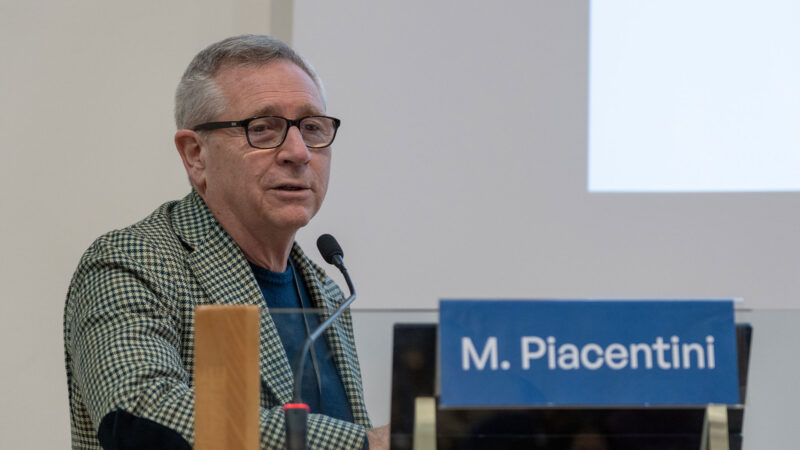
Professor Piacentini, you have an extraordinary career spanning over forty years behind you. When you started out, did you imagine you would end up here, talking about Precision Medicine and a healthcare system so profoundly transformed?
You are taking me back many years now. When I started, let’s say I was thinking about anything but medicine, honestly, and I wanted to do something entirely different. And yet I always had this interest in biology, which led me to study it. But as soon as I began studying cells and everything that follows from that, the application in terms of medical approaches comes almost naturally.
My studies have always had a strong biological foundation but with major applications in the medical field. This is how I ended up directing a laboratory at the Spallanzani where we have studied and continue to study infectious diseases, and much of my work over the past 15 to 20 years has been dedicated to cancer and to the application of our biological knowledge to problems related to oncological diseases.
I must say it has been an extremely interesting journey and even today, despite being retired, I try to remain active in research because one never stops learning. If you stop learning, it is over. We must always question ourselves and seek to grow — this, in my view, should be something of a leitmotif for many people across different fields: always be curious and eager to learn.
And I must say I was always amazed that I was being paid to do what I love. That, in my view, is a privileged condition: having a job that is also your hobby and that allows you to live in a certain way.
Let us get to the heart of our topic. You describe Precision Medicine as “the greatest challenge in healthcare”. What really changes compared to the past?
Precision Medicine is the greatest challenge currently in healthcare and it is already underway — we are not starting from scratch, it is already being applied in various areas of medicine and healthcare. It is in fact a completely different way of looking at the patient.
In the past, and up until today, the patient was a person who had a certain condition and was therefore treated based on the existing experience with that condition. Today the patient becomes the focus of the doctor’s attention as an individual in their own right — their phenotype, genetics, behaviours, lifestyle and the environment in which they live are all taken into account. Every person has their own characterisation in medical terms.
And this is made possible by the technological advances of recent years…
Exactly. This is possible because in recent years technologies and scientific discoveries have made it possible to personalise approaches in the medical field. Technologies have become increasingly precise and increasingly targeted.
But this revolution encompasses a very broad cultural dimension, because there is no Precision Medicine without big data — meaning the ability to manage large quantities of data — and without advanced technologies in both the computing and biomedical fields. It is a small revolution that embraces healthcare but with many fields connected to it.
The patient today should become an individual to be studied as such, no longer as part of a generic class of diseases.
You often speak of “personalised medicine” rather than “Precision Medicine”. Is there a difference?
Personally — and it almost seems like a play on words — I prefer to say personalised medicine because it truly places the patient at the centre of the attention of healthcare professionals and of possible diagnoses and therapies. “Precision” because increasingly sophisticated technologies are used. But in my view we are talking about personalised medicine that uses increasingly advanced, increasingly specific technologies that make it possible to carry out prevention, diagnosis and potentially therapy ever closer to the patient.
Today we can avoid applying certain therapies if we know that the genotype of that individual is not capable of responding adequately to that type of drug or therapy. Often in the past, when medicine was not personalised, general rules for that condition were applied. But today we know that patients are not all the same — they have different genomic histories and therefore some are able to respond to certain therapeutic stimuli while others do not.
There is no point in subjecting them to treatments that often have side effects anyway and incur unnecessary costs for drugs that have no effect on the patient.
Precision Medicine is already a reality in some fields, such as oncology. But there is a problem of access…
Yes, the areas of application that are already underway — but that need to be improved, expanded and made increasingly accessible — are oncology and the cardiometabolic field. And it is beginning to emerge in neurology and in rare diseases as well. There is continuous growth and an ever broader application of these technologies.
Today, thanks to genome analysis that has become increasingly affordable and also more sophisticated from a technical standpoint, it is possible to determine whether a person is more susceptible to developing certain oncological diseases. In the near future, this should become increasingly accessible to the entire population.
At the moment this is not the case and this is one of the limitations: access to Precision Medicine is not open to the entire population but is often linked only to those who can somehow reach certain centres that are capable of providing it and who are aware of it, because people often do not know that these things are available and can be applied.
And it is precisely to overcome these limitations that HEAL Italia was born. Can you tell us about this project?
HEAL Italia was a major bet and still is. Why? First of all, it sought to bring together different realities operating in the healthcare field — from doctors to biologists to computer scientists to technologists — it sought to bring together different realities across different fields. It is a cross-cutting approach to Precision Medicine and this is an almost unique case in Italy.
The Ministry of Health has, for several years, established thematic networks in the medical and healthcare field — six across Italy at present — that seek to homogenise medical approaches on specific topics: oncology, neuroscience, heart, paediatrics, ageing. But these are specific topics, limited to one type of disease.
HEAL Italia, on the other hand, seeks to do something different: to use different capabilities and approaches nationally in a cross-cutting way, not limited to a single disease but seeking to encompass multiple diseases. Because today we know that every disease is connected to other aspects. Diseases must always be viewed more broadly and not restrictively, tied to the specific.
We know, for example, that diabetes influences all cardiological and oncological diseases. Smoking has well-characterised effects in the oncological field but not only — in the cardiological field as well. Many realities must be taken into account.
And you are also creating specialised centres across the territory…
Yes, HEAL Italia is developing and seeking to bring some important realities closer to the patient. Precision Medicine centres specialised in specific fields are being created.
For example, genomics is currently based in Sardinia in Cagliari. We have a centre for cardiometabolic diseases being developed in Rome and Pisa. There is a centre for rare diseases based in Ancona. We are genuinely trying to bring these Precision Medicine approaches closer to the patient.
Over these three years HEAL Italia has made remarkable progress. We hope that the realities we are creating will become fully operational — some already are — and will genuinely bring patients a tangible benefit in the field of Precision Medicine.
We are attracting more and more members: we started with twenty-four, twenty-five institutions, now we are over seventy. And this is precisely because we want to be more cross-cutting and more geographically distributed across all of Italy. We already know that there are many other realities — not only public but also private — that want to join in order to try to create a critical mass in healthcare in Italy.
If we imagine a future in which Precision Medicine becomes routine, what is the most important thing that would change?
First of all, it would be preferable not to arrive at being patients but to have an encounter with Precision Medicine before becoming patients. This is fundamental. Today there is the possibility — and HEAL Italia is moving in this direction — of using knowledge to ensure that diseases are prevented.
I am not saying to predict, but to give an individual information that may allow them to try to avoid the onset of certain diseases to which they are more exposed, at greater risk.
So Precision Medicine should primarily be directed at healthy people, at prevention…
Exactly. In my view, Precision Medicine should be prevention. Let me give you an example: HEAL Italia is promoting — it has not yet launched but the idea is there — a screening of the healthy population for genetic mutations that can lead to the development of cancer, in particular breast cancer.
These are things that can be done. It would be useful not to do them after the tumour has developed. There are other things that are then done if the tumour has developed — the tumour itself is characterised from a genomic standpoint, primarily to understand which are the best therapies to apply. But Precision Medicine can instead be used precisely to try to make the development of certain diseases as unlikely as possible.
If I have certain mutations, I know I may be susceptible to developing certain diseases. If I know this in advance, first of all I can undergo more targeted screening, and secondly I can adopt lifestyles that, as far as possible, avoid exposure to things that may promote this type of disease.
So Precision Medicine should primarily be applied to healthy people in the first instance, and then obviously for other aspects to those who are already ill.
You mentioned a very interesting example: the “Molisani” project. Can you tell us about it?
In HEAL Italia we have a cohort of normal healthy people that has a particular name: they are called the Molisani because they were studied in Molise. There are more than 20,000 people who have been followed for over 20 years by a clinical centre called Neuromed.
These people have been monitored in terms of clinical analyses, lifestyle, environment and nutrition. This is important because today, after 25 years, some of them have obviously developed certain diseases. By going back and studying the genomes of these people we can understand which genes in some way predisposed them to those diseases.
This is why I said that Precision Medicine should first and foremost be directed at prevention and at the study of healthy people above all, and then obviously also at those who develop diseases such as cancer or cardiometabolic conditions.
To make this vision a reality, well-prepared professionals are needed. What competencies will be necessary?
This is an area I have raised in various settings, including with the relevant ministers. In my view there is currently a shortage — and here I speak as a university professor — of training. Current training programmes are anchored to concepts that are not those emerging in the field of Precision Medicine.
An absolute change and update to the content covered by medical studies today is needed. But this is not sufficient because, as I said at the outset, this is a small revolution that involves not only the primary practitioners — the doctors — but also biologists, for example for diagnostics and the use of biomarkers, and computer scientists because big data and artificial intelligence are essential today for applying Precision Medicine in the best possible way.
Today, for example, hundreds and thousands of X-rays can be networked and an analysis is carried out by comparing not only the individual doctor’s experience but that of thousands of other doctors who have conducted similar studies. This is truly important for Precision Medicine to be genuinely precise.
And increasingly the improvement of technologies — because without technological improvement you get nowhere. Biomedical science has always changed when technologies changed, from the advent of the optical microscope to the electron microscope to genomics. Advances in medicine have always been tied to advances in the technological field.
And to the new generations, to those approaching studies in medicine or biology today, what advice would you give?
I think that when it comes to doctors, those who choose to study medicine already have within them the dream of doing that work and of doing it for the good of patients. There is a fundamental vocation. I do not think anyone enrols in medicine because they had no alternatives. It is always a very deliberate and very important choice.
And what I would like to say is that one must not limit oneself to passing the exam — that is the least of the problems. The exam is the last of the problems; knowledge is the real challenge. If I love what I am doing, I must seek to continually expand my knowledge in that field and not only in that field.
So read, study, engage, be curious: this is the foundation for becoming successful in any field, but especially in medicine. Do not settle for the bare minimum. That is an inherently flawed approach.
If I am lucky enough to be able to study the subject I believe I am suited to and interested in, I must do so to the best of my ability. I must be extraordinarily curious, extraordinarily engaged and seek to broaden my horizons as much as possible. Only in this way can one develop a certain level of professionalism, and generally if someone applies themselves, studies and does their best, they also achieve results.
And when work becomes a hobby, then one moves towards the very best.
Professor Piacentini, you believe strongly in HEAL Italia. Why did you decide to invest so much in this project?
I believe strongly in HEAL Italia, which is why I have become so deeply involved — first by becoming vice-president of the Board of Directors, and then more recently even more so as Scientific Director.
I believe this is a way of trying to make a real contribution to Italian healthcare, by seeking to establish realities that until now did not exist or were very much limited only to certain highly specialised centres.
My expectations — and those of all of us as citizens — must be that this more modern approach to medicine becomes increasingly widespread and increasingly accessible to all citizens within the national health service.
Of course this is an objective to be achieved over time — it is not conceivable that Precision Medicine could be applied to everyone overnight. However, in some fields, such as oncology, we are fairly advanced. HEAL Italia can make its contribution because we should seek to launch personalised healthcare campaigns that ensure these personalised approaches are expanded and applied to an ever broader population.
To conclude, Professor Piacentini, how would you define Precision Medicine in one sentence?
Precision Medicine is the medicine of the future that, thanks to increasingly innovative technologies, allows healthcare professionals to approach diagnoses and therapies by focusing on the individual and not on the disease alone.