
DNA does not only give us diseases, it also teaches us how to treat them
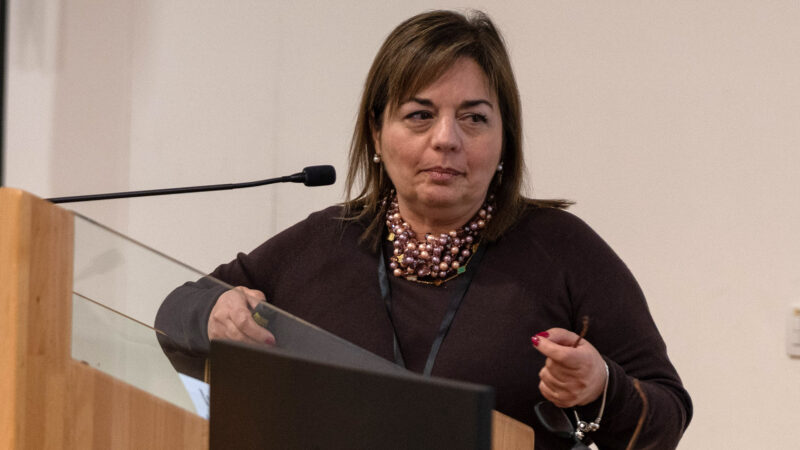
Professor Giglio, when we talk about Precision Medicine, people often think of oncology patients. But who is it really for?
Precision Medicine is for everyone: both for those who have diseases and for people who are healthy. It is an innovative approach, particularly with regard to the prevention of diseases, as well as their treatment. It takes into account our individual characteristics written in the genome, but also our age, the environment we live in and our lifestyle.
This allows us to personalise all our therapies, but also our own lifestyle, because the lifestyle that works for one person is not necessarily the right one for another individual. The result is that the probability of success in responding to therapies increases, and unwanted effects are reduced — not only from drugs but also from our own diet.
You often repeat that “when DNA changes, it does not change only to give us diseases”. What do you mean?
Let us remember that when DNA changes, it does not change only to give us diseases — very often it changes to protect us from diseases as well. What today’s medicine should be studying, besides diseases, is also how DNA protects us. I always love to say that our research should be to analyse DNA and study our genome also to unlock its secrets in treating our diseases.
Within DNA there is also the strategy that DNA uses to correct things that are not working. The more the population’s DNA is studied, the more these secrets are understood: today’s gene therapies were not invented by anyone — we copied the DNA of those individuals who, despite having genetic defects, also had the strategies to correct them. And this applies to all the different types of diseases.
An approach that can truly save the National Health Service money?
Absolutely. Not reaching the point of becoming ill, but managing to prevent diseases, means saving enormous amounts of money. We always say that everyone has the right to health — and rightly so — but we also have the duty to preserve that health. To ensure that ultimately hospital access is needed only in those conditions where it is truly impossible to prevent the disease or to delay it as long as possible over the years.
This must be an educational process above all for all of us — both for doctors but obviously especially for the population. If I want the right to health I must also have the duty to adopt the strategies I need in order not to reach a state of chronicity or a disease so advanced as to require those therapies that often cost the healthcare system a great deal of money.
Let us take a concrete example of how Precision Medicine can change clinical practice.
The first example came from oncology: through the profiling of both the tumour and the patient, specific targeted therapies are found for that type of cancer. And we must expand this approach to all types of diseases — certainly neurological diseases, rare diseases, complex diseases, and the cardiovascular field.
It must be considered that there is a DNA background that gives us precise information. There are genetic conditions — or in any case characteristics of our DNA — that tell us exactly “you must not take that drug” or “you must take it at a different dosage so that those side effects from inadequate drugs or therapies are reduced.” Being able to respond to certain types of therapy from the outset, without trial and error and without harmful side effects, means savings but above all effective therapy.
You often speak of a “pharmacogenetic passport”. What does this involve?
This will be the future: genetic testing for drugs will be carried out by everyone — it will truly become widespread across the entire population. Each of us will have what we might like to call our pharmacological, pharmacogenetic passport. We will know from the outset which drugs we should take or which we should take at certain dosages — and this will also completely change drug expenditure.
It will be a revolution from this perspective too, because it will generate savings. There are already guidelines in place and 14 pharmacogenes already exist, so we already know that some individuals must undergo genetic testing before taking a drug. The population must be educated — or at least informed — about this possibility too. Our hope is that genetic testing for drugs will become a test accessible to everyone through the NHS.
Let us imagine the future: what will the routine of Precision Medicine look like?
We can look at it from two perspectives. Let us suppose someone who is unwell: they arrive at hospital with a disease — for example, autoimmune in nature. If they have not already had their genomic profiling done, it is done immediately. We are moving towards a technology where we will probably be able to sequence DNA in four hours. At that point, since I have read their DNA, I already know which biological drugs they can or cannot take, what dosage they should take and exactly which drug is specific to them. There is no need for extensive trial and error — I prescribe their therapy and they go home within a very short time and will feel better.
For someone who is well, on the other hand: if the individual decides to undergo prevention — for example for cancer — there will be no need to do tumour markers, because I will directly draw plasma, I will look at their circulating DNA and I will know whether they have normal circulating DNA, whether they have inflammation or whether a tumour is beginning. If I see that something is underway, at that point I do not need to administer anti-tumour therapy — I simply need to help the immune system control those tumour clones that are starting out so that they do not become a proper tumour.
Let us talk about HEAL Italia. What role does this project play?
Italy has an important task, because it has had a great idea: to try to harmonise this vision as much as possible at a national level, to bring together many researchers across the various clinical specialties and lead them all towards the same concept — that of using all available information, bringing it together to create better public healthcare for everyone. Our objective is to ensure that all this information from what are today called the omic sciences can be applied on a large scale, across all specialties.
Training is needed, and greater awareness on the part of healthcare professionals, because we must all move in the same direction. There should not be a first-class or second-class medicine — because we see every day that a medicine of the north and a medicine of the south exist.
And this revolution begins precisely from that part of Italy that seems to have fewer structures but has in reality had the best ideas. Let us say that Palermo was the hub of our Precision Medicine — so the two islands were the ones that united Italy!
Many people are afraid of genetics, of “reading their DNA”. How do you respond to these concerns?
I always say that there is no need to be afraid of DNA. Nothing negative is written in DNA. We are always convinced that reading DNA means seeing misfortune — right? Because if it is written in your DNA, it is all over. I assure you that in DNA there is also the strategy that DNA uses to correct things that are not working.
The fear? Everyone is afraid that if I read their DNA, who knows what I might discover — or that they will not be able to work. Obviously we are professionals, and we will tell the patient only what the patient at that moment is able to handle and is able to prevent.
After all, when we decided to do this work we thought we could save the world a little, make people feel well. We do this work to try to make people feel better. If in order to make people feel better I can be helped by this fateful genome — but what is there to be afraid of in knowing the genome?
We are afraid of what we do not know, but we must also have the courage to challenge what we do not know and to try to understand it. Perhaps we understand 30 things today, tomorrow we will understand 50, then 80 and so on — but in the end it only serves to help us feel better.
How do you see the doctor of the future?
All clinicians will have to be geneticists. They will have to know the omic sciences, they will have to be almost computer scientists. They should be able to bring together clinical information and technology. We should become a little bit physicists, a little bit computer scientists.
We will work in close collaboration with STEM disciplines, with professional figures that until now we would not have imagined working inside a hospital. Physicists will work increasingly in clinical settings. There will be engineers working alongside doctors, there will be statisticians and mathematicians, because DNA works like a mathematical process — it is a binary code. Computer scientists understand DNA very well because it works in that way. Everything we create in nature, we create it because we already have it within us. It is simple.
The doctor of the future is a doctor who must not lose their connection with the patient — but the connection with the patient will be completely different. It will be one who also knows how to use artificial intelligence and how to apply it in everyday practice. But remember that clinical judgement — in my view — will never disappear, even in the presence of a healthy individual.
A message to the new generations of doctors and researchers?
Our task is to make people understand how important it is to look at medicine from a different perspective: to unite the omic sciences with everyday clinical practice. At that point, in my view, if someone wants to be a doctor it is impossible not to fall in love with this — impossible!
I believe that anyone, if they are made to understand the importance of bringing these things together, will not only want to administer the injections of aesthetic medicine. Because, for example, if I know my collagens well, I also know how to administer those aesthetic injections much better. But if I do not study DNA, I do not know this!
So to the new doctors I say: do become a doctor — but do it in this way!
What historical moment do you think we are living in?
When I think about what medicine was like when I began compared to today, for me the change has been rapid. In my view, at this moment DNA is driving a revolution in prevention. It is as if we are living through a moment of great revolution — it is like living through the industrial revolution at the end of the nineteenth century, it is exactly the same thing, except that at this moment we cannot quite grasp it. We are witnessing how this approach is completely changing our way of seeing health and life.
Remember that all the greatest revolutions were never born from the top. They were always born from us. They were always born from the people. So if above all we ourselves are not aware of it, we cannot expect change. Revolutions are made from people’s awareness.
The new society that will emerge will have Precision Medicine. It is inevitable. I am absolutely certain of this — there is no going back!
To conclude, how would you define Precision Medicine in one sentence?
Precision Medicine is a new way of providing care that, thanks to the knowledge of our DNA and our health history, allows doctors to establish the most appropriate treatment for each of us. It is medicine that knows us closely and treats each person individually, starting from their DNA.
What is the role of the geneticist in this revolution?
In reality, what should be the task of us medical geneticists? I believe we are the doctors of healthy people. Our task is to be the doctors of people who are well. Our task should be to ensure that people are not hospitalised — except obviously for trauma.
What is a geneticist for? To stop you from falling ill! That is what a geneticist is for. To prevent diseases.
Prof. Giglio actively participates in the HEAL Italia project, contributing to the building of that national network of excellence that is bringing Precision Medicine from research into everyday clinical practice, with the aim of guaranteeing all citizens, from north to south, equal access to innovative and personalised care.