
Biobanks and rare diseases: custodians of a heritage for the medicine of the future
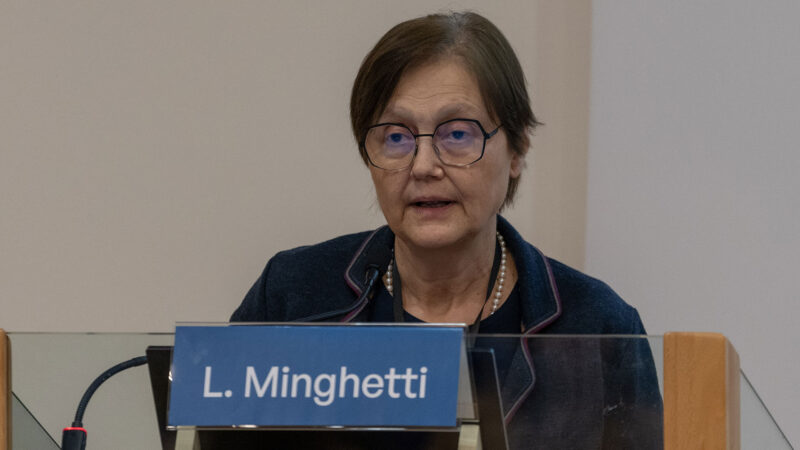
Dr. Minghetti opened her presentation by emphasising the fundamental value of human biological material for research. “We have heard how the information obtained from human biological material, also thanks to the evolution of omic sciences, is central to Precision Medicine,” she stated.
Much of the current knowledge about diseases derives from studies conducted on human biological samples: blood, tissues, cells, DNA. But samples alone are not enough. As Dr. Minghetti clarified, “We are talking about samples, but above all about data: clinical, epidemiological and experimental data that accumulate on these samples over time.”
A blood sample taken from a patient with a rare disease gains value when accompanied by information on the clinical course of the disease, the response to treatments, the genetic characteristics identified and the results of laboratory tests over time. Samples and associated data together constitute critical resources for translating research advances into concrete solutions for human health.
Biological material therefore represents a heritage that must be carefully custodied in biobanks. But this custodianship is not passive: “If samples are collected and managed according to quality criteria — both for the biological matrix and for the associated data — their value grows enormously,” explained Dr. Minghetti. Both samples and data must be cared for, continuing to collect and update them over time.
The principles of responsible research
Research using human biological material must respect fundamental ethical principles, which Dr. Minghetti outlined clearly. Transparency — the procedures for collection, conservation and use of samples must be clear and publicly accessible. Respect for the person — biological material comes from human beings who have dignity and rights that must be protected. Preferential use of residual material — where possible, biological material already collected for clinical purposes should be used rather than subjecting patients to additional sampling. Quality of sample treatment — samples must be processed and conserved according to standardised protocols that guarantee their integrity. Informed consent — participants must be adequately informed and give their explicit consent to the use of samples for research. Privacy protection — sensitive participant data must be protected in accordance with current regulations.
This approach defines what is called “responsible” and “participatory” research, because it actively involves patients and citizens, promoting a climate of trust between society and the research world. Without this trust, patients would not donate their biological samples, and research could not progress.
The biobank as a third-party infrastructure
A key concept in Dr. Minghetti’s presentation was that of the biobank as a “third-party infrastructure.” A biobank is not simply a collection of samples stored in a freezer: it is a structured organisation that guarantees respect for the participant’s wishes, privacy protection, professional custodianship of samples and transparency of access criteria.
The biobank functions as an interface between the patients who donate samples and the researchers who use them. This mediating position is crucial: it allows patients to contribute to research with the certainty that their samples will be used appropriately, and allows researchers to access quality-guaranteed samples accompanied by reliable clinical data.
The central objective of a well-managed biobank is the sharing of samples and data. As Dr. Minghetti effectively stated, “An ideal biobank is ’empty’: this means that the samples are put into circulation, not stored uselessly.”
This statement may seem paradoxical, but it expresses an important truth: biological samples have no value if they remain unused in freezers. Their value is realised when they are used for research that produces new knowledge. An efficient biobank is therefore one that facilitates access to samples by qualified researchers — always, of course, in compliance with the wishes of donors and ethical regulations.
Rare diseases: a paradigmatic case
For rare diseases, the role of biobanks becomes even more crucial. As Dr. Minghetti explained, “There are many of these diseases and they are very different, with few patients for each one. The collection and transparent distribution of rare biological samples is fundamental.”
With over 8,000 known rare diseases, many of which affect only tens or hundreds of patients worldwide, it is impossible for a single research centre to collect a sufficient number of samples to conduct meaningful studies. Sharing through networks of interconnected biobanks therefore becomes not a desirable option, but an absolute necessity.
The rare disease community has been a pioneer in this field, developing collaborative and participatory biobanking models. Researchers, patients and families understood early that only by working together — sharing resources and knowledge — would it be possible to make significant progress.
The Telethon Network: a virtuous example
Dr. Minghetti cited as a virtuous example the Telethon network of genetic banks, an initiative that began in 2007. Today this network consists of 11 biobanks conserving over 100,000 samples related to more than 1,000 rare genetic diseases.
The Telethon Network is not merely a collection of biobanks: it is an integrated system with shared protocols, interconnected databases, common governance and transparent access policies. It has played a central role in international projects such as RD-Connect, demonstrating how a well-organised national infrastructure can become an important node in European and global networks.
The success of Telethon also demonstrates the importance of continuous funding from dedicated foundations. While competitive research funding has limited duration (typically 2–5 years), biobanks require long-term support to maintain collections, update data, guarantee quality and provide services.
HEAL ITALIA and the national biobank network
Within the HEAL ITALIA programme, biobanks take on a strategic role. As Dr. Minghetti explained, “This is not a simple research project, but an investment programme involving over 70 partners, active across multiple fields of Precision Medicine, including rare diseases.”
Already in the design phase, one of the identified strengths of the consortium was the presence of human biological material in several partner biobanks. From this arose the objective of creating a HEAL ITALIA biobank network to promote the use and culture of biobanking.
The strategy adopted is intelligent and pragmatic: “We want to build this network without duplicating already existing realities, but by entering into synergy with national and international structures,” stated Dr. Minghetti. This is therefore not about creating a parallel infrastructure, but about integrating HEAL ITALIA biobanks into existing networks, bringing added value and benefiting from the competencies already developed.
BBMRI-Italia: the national node of the European infrastructure
The main partner for this integration is BBMRI-Italia (Biobanking and Biomolecular Resources Research Infrastructure — Italia) — the national node of the European research infrastructure BBMRI-ERIC. BBMRI-Italia, established in 2013, today counts almost 100 biobanks, involving universities, IRCCS, research institutions, patient associations and industrial partners.
Some HEAL ITALIA partners are already part of BBMRI-Italia, such as the Istituto Tumori Regina Elena and the Istituto Mario Negri. This will facilitate the integration of other HEAL ITALIA biobanks into the network. The objective is for the HEAL ITALIA biobanks to become part of the BBMRI-Italia thematic network for Precision Medicine.
But HEAL ITALIA can also contribute to strengthening BBMRI-Italia by helping to “develop new infrastructural nodes, filling the geographical gaps in the distribution of biobanks.” Currently, Italian biobanks are concentrated primarily in some regions of the North and Centre. Developing new certified biobanks in the less covered geographical areas would contribute to reducing territorial inequalities in access to Precision Medicine.
Strengthening BBMRI: digital enhancement
In parallel with HEAL ITALIA, another PNRR project called “Strengthening BBMRI” is active, funded with approximately 24 million euros. This project aims to strengthen the digital competencies of biobanks and improve the interoperability and exposure of resources at a European level.
The digital aspect is crucial for modern biobanks. It is not enough to conserve quality samples: information about these samples must also be made accessible to researchers through online databases, searchable catalogues and standardised request systems. Interoperability between the different IT systems used by different biobanks is needed.
Dr. Minghetti showed a concrete example: the BBMRI-Italia website, where a “Community of Practice” has been developed — a platform in which biobanks present themselves, share tools and practices, and make themselves visible and accessible. She cited as a virtuous example the biobank of the AOU Pisana — the first Italian biobank to be accredited with the ISO 20387 standard in 2022.
This ISO certification represents an important milestone: it demonstrates that the biobank complies with international quality standards in the management of biological samples and associated data. It is a signal of reliability for researchers who wish to use the samples and for the patients who donate them.
Towards an integrated and interconnected network
The vision presented by Dr. Minghetti is clear: to build a HEAL ITALIA biobank network interconnected with BBMRI-Italia and, through this, with the European infrastructure BBMRI-ERIC. This network must be capable of guaranteeing quality in the collection, processing and conservation of biological samples and data; transparency in access criteria and operational procedures; facilitated access to samples and data for qualified researchers; sustainability through long-term funding models; and growth by supporting the establishment of new biobanks in areas of the territory not yet covered.
This infrastructure does not serve academic research alone. As highlighted in Prof. Giua Marassi’s presentation the previous day, the pharmaceutical industry needs access to biological samples and patient data to make informed decisions about investments in new drug development. A well-organised biobank network — with clear access procedures also for industrial partners — facilitates technology transfer and accelerates the translation of research into therapies.
The role of the Istituto Superiore di Sanità
The Istituto Superiore di Sanità, where Dr. Minghetti works, plays a role of coordination and strategic support for Italian biobanks. As a research and technical-scientific advisory body of the National Health Service, the ISS can facilitate the standardisation of protocols, promote best practices, support integration with European networks and contribute to the training of operators.
The presence of the ISS in HEAL ITALIA and its involvement in the development of the biobank network ensures that the infrastructure is built according to high standards and in continuity with existing national and European initiatives, avoiding fragmentation and duplication of efforts.
An ecosystem for Precision Medicine
Dr. Minghetti’s presentation highlighted how biobanks are an essential element of the ecosystem necessary for Precision Medicine in rare diseases. Sophisticated omic analysis technologies, artificial intelligence for data interpretation and specialised clinical expertise are not sufficient on their own. A solid infrastructure is also needed to collect, conserve, characterise and share human biological samples and associated data.
This infrastructure must be built on the principles of responsible and participatory research, fully respecting the rights and dignity of the people who donate their samples. Only in this way can the trust of society be maintained — without which biomedical research cannot progress.
The integration of HEAL ITALIA biobanks into existing national and European networks represents an intelligent model of infrastructural development: instead of creating parallel systems, the existing framework is strengthened and expanded, bringing competencies and resources where they are most needed, filling geographical gaps and increasing interoperability.
As Dr. Minghetti concluded, the objective is “to build a HEAL ITALIA biobank network interconnected with BBMRI-Italia, capable of guaranteeing quality, transparency and access to samples and data, and of supporting the establishment of new biobanks in the areas of our territory not yet covered.” An ambitious but concrete objective that represents a fundamental piece in realising the promise of Precision Medicine for all patients with rare diseases, wherever they may be in Italy.