
DIASMOKE: An Innovative Study on Cardiovascular Risk in Diabetic Smokers
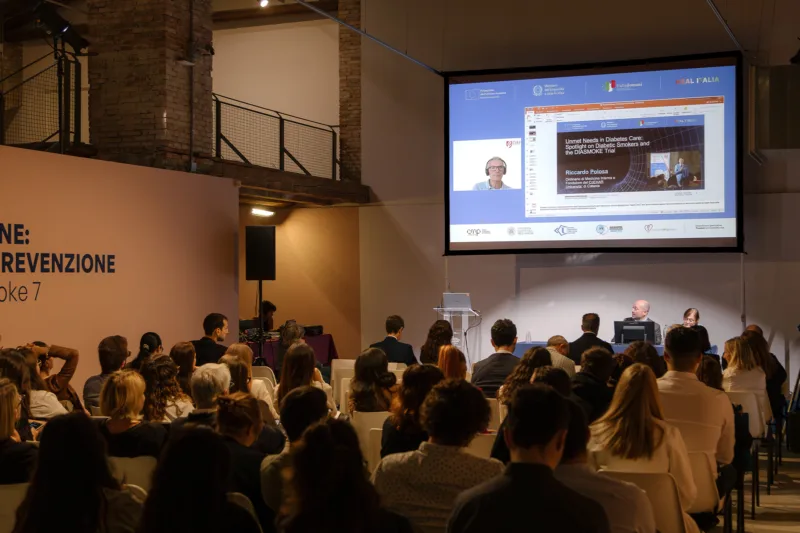
The project, whose full title is “DIASMOKE – Randomized Control Trial Evaluating Changes in Cardiovascular Risk in Type 2 Diabetic Patients Who Switch to Combustion-Free Nicotine Delivery Systems”, addresses in an innovative way the impact of cigarette smoking on cardiovascular risk in a particularly vulnerable population: type 2 diabetic patients, who already carry an elevated cardiovascular risk. The presentation fits within the broader framework of Spoke 7, dedicated to prevention strategies, which Prof. Moroncini organized by integrating four Work Packages focused respectively on tumors, cardiovascular diseases, endocrine-metabolic conditions, and specific case studies.
The Problem of Diabetic Smokers: A Public Health Gap
Prof. Polosa opened by emphasizing the extraordinary opportunity offered by the HEAL ITALIA project to conduct innovative research on a topic that affects large segments of the national and international population, with potential ramifications at a global level. But why is it so important to discuss diabetic smokers today?
The scientific literature extensively documents the relationship between the damage caused by smoking and that caused by hyperglycemia. However, the most alarming aspect is that the combined effect of these two factors is not simply additive, but synergistic. This means that the simultaneous presence of smoking and diabetes exponentially amplifies cardiovascular risk, particularly with regard to macrovascular complications such as myocardial infarction and stroke.
A Neglected Population
A particularly concerning aspect concerns the epidemiology of smoking. Although a general decline in smoking prevalence is being observed, especially in Western societies, this positive trend does not specifically extend to individuals with diabetes. A form of resistance to all conventional tobacco control interventions exists within this population, making this group particularly difficult to reach through traditional preventive strategies.
The scale of the problem is far from negligible. Globally, at least 120 million diabetic smokers are estimated, while in Italy this population amounts to approximately 800,000 individuals. This is therefore a numerically significant group that, paradoxically, is systematically overlooked when prevention policies and public health interventions are planned.
The Benefits of Cessation: Evidence and Limitations
Scientific evidence clearly demonstrates that smoking cessation or abstinence interventions yield significant benefits in diabetic patients. In particular, benefits are well documented with regard to cardiovascular risk reduction and improvement of diabetic nephropathy. For other aspects of the micro- and macrovascular complications of diabetes, the literature has not provided equally clear and definitive answers.
However, the true obstacle to smoking cessation lies in the highly addictive nature of smoking. As Prof. Polosa put it effectively: “quitting smoking is easy to say, hard to do.” This simple observation underscores the need for alternative and more effective approaches for this patient population.
Identified Gaps in Diabetes Management
The DIASMOKE project was born precisely from the identification of clear gaps in the clinical management of diabetes mellitus. The first and most evident of these concerns the fact that smoking status is largely ignored not only in everyday clinical practice, but also in major clinical trials and, surprisingly, in international guidelines.
The research group conducted a systematic analysis of the leading international diabetes guidelines, discovering that the issue of smoking is barely mentioned — in half a page or three-quarters of a page — within documents that often run to 200–300 pages in total. This disproportion highlights a glaring underestimation of the problem.
Toward Personalized Medicine for the Diabetic Smoker
A second fundamental gap identified by the research is the absence of a smoking cessation therapy specifically tailored to diabetic smokers. This directly evokes the concept of personalized medicine, a central theme of the HEAL ITALIA project. Furthermore, the possibility of risk reduction through the use of new technologies that deliver nicotine without combustion is not adequately considered in current therapeutic strategies.
Although conventional smoking cessation strategies exist, the scientific literature highlights that their success is very limited, particularly in the diabetic population. A critical element is the complete absence of randomized trials evaluating the efficacy and safety of nicotine alternatives in diabetic patients. Consequently, the long-term effects of these products — both on vascular and metabolic aspects — remain entirely unknown.
The DIASMOKE Project: Design and Methodology
The DIASMOKE project represents a scientifically rigorous response to these identified gaps. It is a large-scale multicenter study designed to enroll 576 subjects with type 2 diabetes mellitus.
Study Design
The study design follows the gold standard criteria of clinical research. Patients are randomized into two distinct treatment arms. The first arm receives the current standard of care, which includes anti-smoking advice, counseling sessions, and conventional support for smoking cessation. The second arm, by contrast, receives alternative nicotine-containing but combustion-free products, provided through a “basket” of different options.
The overall duration of the project is two years — a period sufficiently long to assess meaningful changes in both metabolic and cardiovascular outcomes. The primary endpoint of the study is the assessment of metabolic syndrome prevalence in the two patient groups. Secondary endpoints include a comprehensive set of metabolic and cardiovascular parameters, as well as evaluation of participants’ quality of life.
Technological Innovation: The Tracker App
A particularly innovative aspect of the DIASMOKE project is the use of a tracker app developed specifically for this study. This application enables real-time monitoring of patient behaviors and changes in their consumption patterns — both regarding the use of alternative nicotine products and the progressive discontinuation of traditional cigarettes.
The importance of this technological tool is such that the research team obtained an Italian patent for the application, and the procedure to obtain a European patent is currently underway. This represents not only a scientific achievement, but also a potential technological asset with commercial value and future clinical applicability.
The Potential Impact of the Research
Prof. Polosa clearly outlined the potential impact of this research across three fundamental levels. First, DIASMOKE represents the world’s first trial to specifically evaluate cardiovascular risk reduction through the transition to reduced-risk products in the diabetic population. This pioneering aspect confers upon the study a unique scientific value at the international level.
Second, the study will make it possible to determine whether the transition from traditional cigarettes to low-risk products can actually alter metabolic and cardiovascular indices in diabetic patients. This knowledge is essential for developing evidence-based therapeutic strategies.
Third — and this is perhaps the most significant aspect from the standpoint of precision medicine and public health — the ultimate goal is not simply the publication of scientific papers to enrich academic curricula. As Prof. Polosa emphatically stressed, this entire body of information must be translated into international guidelines and policy guidelines to be adopted by individual states. The ultimate ambition is to radically transform the management of the diabetic smoker and offer concrete opportunities capable of positively changing the lives of these patients.
The Global Dissemination Strategy
A distinctive feature of the DIASMOKE project is its strategy for disseminating and implementing results at a global level. The research team has not limited itself to conducting the clinical trial, but has developed a far broader and more articulated vision.
The International Expert Network
The strategy first envisions the creation of a solid network of partners and key opinion leaders who themselves become the driving force of the project. These experts are tasked with transferring the knowledge gained through the trial and related activities, actively disseminating findings at the level of their respective scientific societies in their home countries.
This approach enables an exponential amplification of results dissemination, effective integration of guideline implementation, and a truly global expansion of the project’s impact. This is therefore not a simple academic study confined to a handful of institutions, but an international scientific movement with transformative ambitions.
The Global Database
One of the most significant achievements of the project’s first two and a half years has been the development of what Prof. Polosa described as a vast database, comprising over 250 patient associations and scientific societies across more than 200 countries. This network represents a unique strategic asset for disseminating results and implementing changes in clinical practices worldwide.
Interim Results: Achievements and Progress
Two and a half years into the project, despite the challenges encountered, the results achieved are remarkable. Patient recruitment proved more complex than anticipated: over 3,000 patients were screened to enroll 417 at the time of the presentation. This figure reflects the stringency of the selection criteria and the complexity of the study.
The International Scientific Advisory Board
One of the project’s greatest assets, according to Prof. Polosa, has been the formation of a high-caliber international Scientific Advisory Board. This body has not remained idle: the team has not simply focused on the clinical trial, but has activated a series of ancillary activities of considerable scientific value.
The group began producing scientific articles on related topics, progressively realizing that these works could be integrated into a broader and more comprehensive document: international guidelines on smoking in diabetes. The group’s first formal meeting was held in Catania in March 2023, and even at that early stage the panel offered sharp criticism of the American guidelines for failing to adequately address the issue of smoking in diabetic individuals.
Scientific Output
Over the course of two years, the group published seven high-impact scientific papers on issues of central relevance to the lives of diabetic individuals. These articles collectively achieved a global Altmetric score exceeding 300 and recorded over 34,000 accesses. These figures testify not only to the scientific quality of the work, but also to the interest and attention that the international scientific community is devoting to this subject.
Future Perspectives: Toward International Guidelines
To maximize the impact of the DIASMOKE project, the team has outlined an ambitious yet concrete roadmap. The first objective is to complete the guidelines on smoking cessation in diabetes. The document — already virtually finalized — consists of 11 chapters spanning over 70 pages, developed over two years of intensive work.
The Review and Validation Process
The guidelines will undergo an internal review process through the global network the team has built. The ambitious goal is to have the document reviewed by over 2,000 international experts, collecting their suggestions and comments prior to final submission for publication. This broad validation process will ensure that the document truly represents an international consensus, rather than simply the opinion of a small group of researchers.
The Catania Consensus Conference
The culmination of this process will be the Consensus Conference scheduled for November 9, 10, and 11, 2025 in Catania. This event will bring together 28 international experts from 20 different countries, who will work intensively to create a full-fledged Delphi Conference. This methodologically rigorous instrument represents, according to Prof. Polosa, a powerful tool for educating colleagues who are unaware of the opportunities offered by smoking cessation specifically in the diabetic population.
During the presentation, Prof. Polosa extended a formal invitation to the HEAL ITALIA leadership, to Prof. Moroncini and Dr. Minghetti, to participate in this pivotal event — to witness firsthand the work of the international experts and the Consensus Conference proceedings.
Implications for Precision Medicine
The DIASMOKE project represents a paradigmatic example of how precision medicine can be applied to one of the most complex and underserved intersections of chronic disease management. By addressing the specific needs of diabetic smokers — a population that is simultaneously at high cardiovascular risk and resistant to conventional cessation strategies — the project embodies the core principles of personalized, evidence-based care. Its integrated approach, combining a rigorous randomized trial with cutting-edge digital tools, international collaboration, and a clear pathway toward guideline reform, positions DIASMOKE as a model for how translational research can generate real-world impact beyond the boundaries of academic medicine.

Read more Insights