

Predicting Cancer Risk in the Italian Population: A Study on Male Breast Cancer
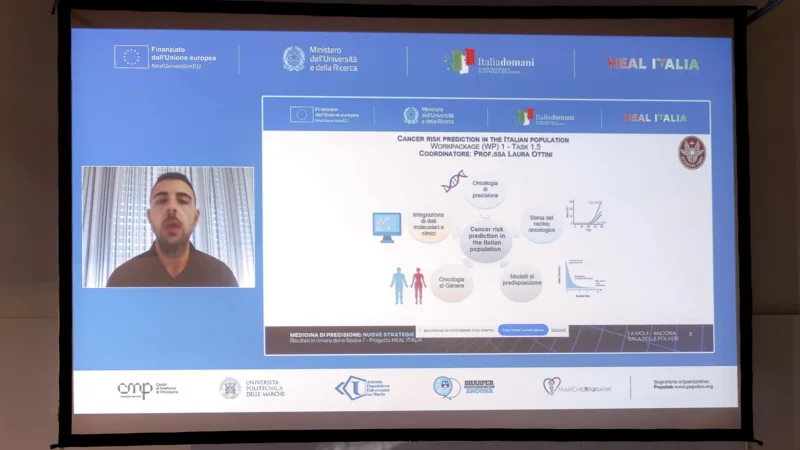
Dr. Agostino Bucalo opened his presentation by thanking Prof. Moroncini for the introduction and presenting the main theme of TASK 1.5, directed by Prof. Laura Ottini, which is concerned with predicting cancer risk in the Italian population. As the speaker highlighted, the primary objective is the prediction of cancer risk in the Italian population, contributing to the creation of predisposition models and the estimation of oncological risk.
This approach aims to advance oncology towards ever greater precision through the integration of both molecular and clinical data. The specific research objectives include three main directions: investigating and characterising genetic susceptibility to cancer in the Italian population; evaluating polygenic risk scores currently developed and personalising them for the Italian population; and developing specific personalised polygenic risk scores (PRS) and tools to integrate genetic analysis with environmental factors at the level of the Italian population.
Male breast cancer: a model for Precision Medicine
The laboratory directed by Prof. Laura Ottini has for many years been engaged in the study of male breast cancer — a neoplasm that, despite its rarity, presents peculiar characteristics that make it a particularly interesting study model for oncological Precision Medicine.
Male breast cancer represents approximately 1% of all breast cancers and less than 1% of all male tumours, but its incidence has been constantly increasing over recent decades. The genetic component plays a particularly relevant role in this neoplasm, making it an excellent model for studying hereditary susceptibility to cancer.
Study methodology: next generation sequencing
The study uses next generation sequencing (NGS) technologies to analyse a broad panel of genes associated with cancer susceptibility. The protocol followed in the laboratory refers to the Illumina DNA enrichment protocol, which involves several phases: an initial pre-amplification phase and a post-amplification stage. The key points of this protocol are the various purification phases and, above all, the amplification phases of the target sequences — that is, the regions of interest.
Samples are processed using a multigene panel that initially includes 50 genes associated not only with breast cancer but also with other solid tumours. This choice allows a broader view of oncological genetic susceptibility to be obtained.
The central role of the BRCA genes
The BRCA2 and BRCA1 genes are responsible for approximately 15% of all breast cancers in the general population. However, their importance is even greater in male breast cancer, where they represent the main identified genetic cause.
Despite this, more than 80% of male breast carcinoma cases are not associated with pathogenic variants in known BRCA genes. This observation has driven researchers to broaden the analysis in order to identify other genes involved in susceptibility to this neoplasm.
The case-control study and initial results
The research group conducted a case-control study published in the European Journal of Cancer, which analysed 767 cases of male breast carcinoma negative for mutations in BRCA genes, compared with healthy male controls. This study revealed that the most frequently mutated genes — in addition to BRCA — are PALB2 and ATM, followed by CHEK2, MLH1 and other susceptibility genes.
With the aim of continuing to screen the case series to better understand the susceptibility and genetic component underlying this condition, the analysis was broadened by recruiting new cases and new controls. To date, 1,189 cases of male breast carcinoma and 1,507 healthy male controls have been analysed — representing one of the largest case series at international level.
The distribution of mutations in susceptibility genes
In the updated analysis, the most frequently mutated genes are BRCA2 in more than 12% of male breast cancer cases, followed by BRCA1 in more than 1.5% of cases, and then PALB2 and ATM. These data confirm the central role of BRCA2 in genetic susceptibility to male breast carcinoma in the Italian population.
With the objective of better identifying and understanding oncology of gender, thanks to the case-control study and previous data, the group was able to compare genetic susceptibility between female and male breast cancer for the main predisposition genes, highlighting the key role of BRCA2 specifically in male breast cancer.
Copy Number Variations: exploring the “missing” genetic component
To deepen the understanding of genetic susceptibility and focus on the still-missing part of the genetic component, researchers extended the analysis to a different type of genomic alteration: Copy Number Variations (CNV) — that is, alterations in the number of copies of specific DNA regions.
For this analysis, a new methodology called Digital MLPA was used, which involves integrating classical MLPA (Multiplex Ligation-dependent Probe Amplification) with next generation sequencing. A multigene panel of 28 genes associated not only with breast cancer but also with other solid tumours was used.
This CNV analysis was performed on a selected cohort of 147 cases of male breast carcinoma negative for the mutations previously identified through panel analysis, but presenting clinical characteristics suggestive of a hereditary component: personal history of other types of tumours in addition to breast cancer, presence of bilateral tumour, or young age at diagnosis.
Results of the Copy Number Variation analysis
The CNV analysis performed by Digital MLPA revealed that 2% of the male breast carcinoma cases analysed present pathogenetic Copy Number Variations. Specifically, the following were identified: a deletion of exon 15 of the BRCA2 gene in one case; a deletion of exons 10 and 11 of the BRCA2 gene in another case; and a deletion of exon 8 of the CHEK2 gene in a further case.
These results demonstrate the importance of extending genetic analysis beyond point mutations, also including structural DNA alterations that can contribute significantly to oncological susceptibility.
Summary of genomic analysis: 18.4% of cases with genetic alterations
Summarising the genomic analysis conducted to date in the Italian multicentre series of male breast carcinoma, combining panel analysis (point mutations) and Copy Number Variation analysis (structural alterations), 202 cases of male breast carcinoma carrying a genetic alteration were identified — representing 18.4% of the total cases analysed.
As can be observed from the data, BRCA2 and BRCA1 represent the most frequently mutated genes in the population, followed by PALB2 and other genes representing approximately 3–4% of alterations. Among these genes, PALB2 and ATM have confirmed their key role in susceptibility to male breast cancer.
These data were presented and discussed at the meeting of the Italian Society of Cancerology held in Turin in December 2024, contributing to knowledge of the genetic basis of male breast cancer in the Italian population.
Polygenic risk: beyond high-penetrance genes
In addition to characterising the risk linked to individual high-penetrance genes, studies have been conducted in Prof. Ottini’s laboratory to evaluate polygenic risk in male breast carcinoma. This approach represents an important paradigm shift in the assessment of oncological risk.
From previous Genome-Wide Association (GWAS) studies, 313 common genetic variants — called SNPs (Single Nucleotide Polymorphisms) — have emerged that are associated with an increased risk of developing breast cancer. The fundamental characteristic of these SNPs is that individually they do not confer a significantly increased risk of breast cancer, but when multiple SNPs are present in the same individual, the risk increases cumulatively.
The Polygenic Risk Score: a cumulative model of risk
The concept underlying the Polygenic Risk Score (PRS) can be visualised through a Gaussian distribution: individuals presenting few SNPs have a low risk of breast cancer, while the risk increases progressively as the number of SNPs present in the same individual grows. This cumulative effect makes it possible to stratify the population into different risk categories.
A particularly interesting aspect to emerge from the study is the comparison between the distribution of the 313 SNPs in female breast cancer and in male breast cancer. The two distribution curves proved to be very similar, indicating that these SNPs are involved in a similar manner in susceptibility to both forms of the disease.
Gender differences in genetic susceptibility
As Dr. Bucalo emphasised, up to this point in the analysis it has emerged that the genes involved in susceptibility to male breast cancer are substantially the same as those of female breast cancer. However, what is gender-specific is the weight that each individual gene and each individual variation carries in the predisposition to the tumour itself.
This observation is fundamental for Precision Medicine: it is not enough to identify which genes are involved — it is necessary to understand how their contribution to risk varies as a function of sex, age and other individual factors. This knowledge makes it possible to develop more accurate and personalised predictive models.
Future projects: towards integrated multigene panels
The future projects of the research group envisage the creation of a new multigene panel that will no longer include the 50 genes analysed indiscriminately up to now, but a targeted selection of genes that have been demonstrated to be definitely involved in susceptibility to male breast cancer, with the subsequent addition of the 313 SNPs identified in GWAS studies.
This integrated approach will make it possible to obtain a general and complete view of genetic susceptibility to male breast cancer in Italy, combining the analysis of high-penetrance genes (which confer high risks but are rare) with that of common low-penetrance genes (which confer modest risks but, being very widespread in the population, contribute significantly to overall risk).
International collaborations: the CONFLUENCE Consortium
The research group is also participating in new international consortia, including the CONFLUENCE Consortium. This international consortium conducts large GWAS studies on various solid tumours — including breast cancer — with the objective of identifying new genetic variants and new SNPs.
Participation in these consortia is fundamental for several reasons: it allows the analysis of case series far larger than those available at national level, increasing the statistical power of the studies; it enables comparison of Italian data with those from other populations, identifying variants that are specific or common across populations; and it facilitates the discovery of new genetic variants through meta-analyses that combine data from multiple studies.
The ultimate objective is to develop an increasingly targeted and specific polygenic risk score for male breast cancer, which can be used in clinical practice to identify individuals at greatest risk and implement personalised surveillance and prevention strategies.
The importance of an Italian multicentre case series
As Dr. Bucalo concluded, the methodological approach of the study is based on a broad multicentre case series of male breast cancer, collected thanks to the collaboration of numerous Italian centres, together with the use of next generation sequencing (NGS) technologies. This combination makes it possible to obtain an overview of genetic susceptibility to male breast cancer in the Italian population.
The integration of high-penetrance gene analysis with Copy Number Variation analysis and polygenic risk scores represents a comprehensive and multi-level approach to the characterisation of oncological risk. This model can be extended to other tumour types and represents an example of how Precision Medicine must integrate different levels of genetic information to provide an accurate estimate of individual risk.
Clinical and translational implications
The results of this study have important clinical implications. The identification of the genetic component underlying male breast cancer makes it possible to offer targeted genetic tests to patients with male breast cancer and their family members; to stratify oncological risk more accurately, identifying individuals who could benefit from intensified surveillance programmes; to provide useful information for oncological genetic counselling; and to contribute to understanding the biological mechanisms underlying mammary carcinogenesis.
The development of polygenic risk scores specific to the Italian population is particularly relevant, since these tools must be calibrated on the reference population in order to be accurate. Genetic variability between different populations can in fact significantly influence the performance of these predictive models.
Towards personalised oncological prevention
The study presented by Dr. Bucalo represents a concrete example of how research in Precision Medicine is evolving towards increasingly personalised and multi-dimensional approaches. The combination of high-penetrance gene analysis, Copy Number Variations and polygenic risk scores makes it possible to stratify oncological risk with unprecedented precision.
This approach opens the way to truly personalised prevention strategies, where the intensity and frequency of surveillance — as well as any preventive interventions — can be modulated on the basis of the individual genetic risk profile. Male breast cancer, though a rare neoplasm, represents an important model for developing and validating these approaches, which can then be extended to other more frequent tumour types.
The presentation at the HEAL Italia conference highlighted how Italian research in this field is at the forefront — with one of the largest case series at international level and an innovative methodological approach integrating different technologies and levels of genetic analysis. Future projects, envisaging the expansion of genetic panels and participation in international consortia, promise further advances in the understanding and prevention of male breast cancer in the Italian population.

Read more Insights